



Can Robotics Transform Every Industry by 2034? Here's What the Future Holds
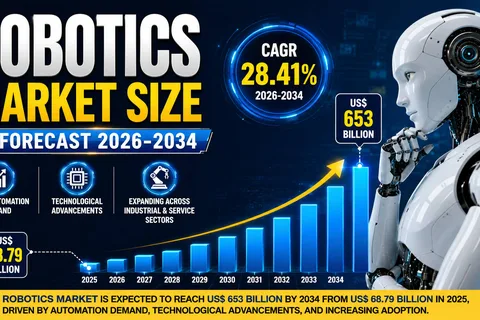
Introduction Robotics is no longer confined to futuristic concepts or highly specialized manufacturing plants. Today, robots are performing surgeries, managing warehouses, harvesting crops, assisting hotel guests, inspecting infrastructure, and collaborating with workers on factory floors. As businesses worldwide pursue higher productivity, improved operational efficiency, and greater workplace safety, robotics has become one of the fastest-growing technology sectors. According to Renub Research, the global robotics market is projected to grow from US$ 68.79 billion in 2025 to an impressive US$ 653 billion by 2034, expanding at a remarkable compound annual growth rate (CAGR) of 28.41% between 2026 and 2034. This extraordinary growth reflects rising investments in automation, continuous technological innovation, and increasing demand for intelligent robotic systems across virtually every major industry. The robotics revolution is not simply replacing manual labor—it is redefining how businesses operate, improve quality, reduce costs, and respond to rapidly changing market demands. Why Robotics Has Become a Business Priority Organizations across the globe are under increasing pressure to produce more while maintaining consistent quality and reducing operational expenses. At the same time, labor shortages, rising wages, and growing customer expectations are encouraging companies to automate repetitive and complex tasks. Modern robotic systems help businesses improve productivity, enhance manufacturing precision, reduce workplace injuries, minimize production errors, lower long-term operational costs, and operate continuously with minimal downtime. Unlike traditional automation systems, today's robots are intelligent enough to analyze data, adapt to changing environments, and work collaboratively with human employees. As digital transformation accelerates, robotics is becoming one of the most valuable investments organizations can make. Artificial Intelligence Is Redefining Robotics The newest generation of robots relies heavily on artificial intelligence and machine learning to perform increasingly sophisticated tasks. Rather than simply following pre-programmed instructions, AI-powered robots can recognize objects, interpret visual information, make decisions, and continuously improve their performance using real-time data. Computer vision allows robots to inspect products for defects with incredible precision, while advanced sensors enable them to safely navigate warehouses, hospitals, and manufacturing facilities. Machine learning also allows robotic systems to predict maintenance requirements before failures occur, reducing costly downtime and improving operational reliability. Cloud computing and the Internet of Things (IoT) further strengthen robotics by enabling centralized monitoring, remote management, and data-driven optimization across multiple robotic systems simultaneously. Collaborative Robots Are Changing Manufacturing One of the fastest-growing segments within the robotics industry is collaborative robotics. Unlike conventional industrial robots that operate behind safety barriers, collaborative robots—commonly known as cobots—are specifically designed to work safely alongside human employees. Cobots assist workers with repetitive, physically demanding, or highly precise tasks while allowing humans to focus on creativity, quality control, and decision-making. Because collaborative robots require less factory redesign and lower upfront investment than traditional robotic systems, they have become particularly attractive for small and medium-sized manufacturers seeking affordable automation solutions. Their flexibility is making advanced robotics accessible to businesses that previously could not justify large-scale automation investments. Industrial Robotics Continues to Lead the Market Industrial robots remain the largest contributor to overall robotics revenue. Manufacturers increasingly rely on robots for welding, assembly, painting, material handling, packaging, quality inspection, precision machining, and automated inspection processes that improve efficiency while maintaining consistent product quality. Industries such as automotive, electronics, heavy machinery, chemicals, food processing, and plastics continue expanding robotic deployments to improve production efficiency and reduce operational risks. As smart factories become increasingly common, industrial robots are expected to become even more intelligent through AI integration and predictive analytics. Healthcare Emerges as a Major Growth Opportunity Healthcare is rapidly becoming one of the most exciting applications for robotics. Robotic-assisted surgery provides greater precision while reducing blood loss, minimizing complications, and shortening patient recovery times. Hospitals also use robots for transporting medicines, disinfecting operating rooms, delivering supplies, supporting rehabilitation programs, monitoring patients, and assisting medical professionals with routine tasks. Elderly care is another promising area as aging populations increase demand for assistive technologies capable of supporting independent living. Medical robotics continues attracting significant investment due to its ability to improve both patient outcomes and healthcare efficiency. Logistics and Warehousing Drive Automation Demand Global e-commerce growth has transformed warehouse operations. Retailers and logistics providers increasingly depend on autonomous mobile robots to move inventory, sort packages, optimize storage, accelerate order fulfillment, reduce operational delays, and improve inventory management. Warehouse robotics improves inventory accuracy while significantly reducing manual labor requirements. Autonomous guided vehicles, robotic picking systems, and AI-powered fulfillment technologies enable companies to meet growing consumer expectations for faster deliveries while controlling operating expenses. As online shopping continues expanding worldwide, logistics robotics is expected to remain one of the industry's fastest-growing segments. Agriculture Enters the Robotics Era Agriculture is experiencing its own automation revolution. Farmers increasingly use robotics for planting, harvesting, spraying crops, monitoring soil conditions, detecting plant diseases, improving irrigation, and optimizing fertilizer usage. AI-powered agricultural robots improve productivity while reducing labor dependency and minimizing chemical usage through precision farming techniques. Autonomous tractors, robotic harvesters, and intelligent irrigation systems help farmers maximize crop yields while supporting sustainable agricultural practices. As food demand rises globally, agricultural robotics is expected to play an increasingly important role in ensuring food security. Government Support Accelerates Innovation Governments across the world increasingly recognize robotics as a strategic technology capable of improving national productivity and economic competitiveness. Many countries now provide research grants, innovation funding, tax incentives, public-private partnerships, Industry 4.0 initiatives, smart manufacturing programs, technology incubation support, and robotics-focused research investments that encourage businesses to embrace automation. These initiatives encourage businesses to adopt automation technologies while supporting universities and research institutions developing next-generation robotic solutions. Public investment is helping reduce commercialization barriers while accelerating technological advancement. Recent Industry Developments Signal Strong Momentum The robotics industry continues witnessing major strategic investments and technological breakthroughs. Leading automation companies are expanding research activities while venture capital firms continue investing heavily in AI-focused robotics startups. Defense organizations are increasing adoption of autonomous robotic systems for surveillance, logistics, and counter-drone operations. Healthcare companies continue introducing increasingly sophisticated robotic surgical platforms capable of improving clinical precision. Meanwhile, software developers are building AI-native robotics platforms capable of learning and adapting more effectively than previous generations. These developments demonstrate strong confidence in robotics' long-term growth potential. Challenges That Still Need Attention Despite exceptional opportunities, robotics adoption faces several important challenges. The largest obstacle remains the high initial investment required for hardware, software integration, infrastructure upgrades, and employee training. Many smaller organizations struggle to justify significant upfront expenses despite attractive long-term returns. Technical integration also presents difficulties. Organizations frequently need to redesign workflows and modernize legacy systems before implementing advanced robotics successfully. Cybersecurity has become another growing concern as connected robotic systems exchange increasing volumes of operational data. Finally, the shortage of skilled robotics engineers, programmers, automation specialists, and AI professionals continues limiting deployment across many regions. Addressing these challenges will remain essential for sustaining long-term industry growth. Regional Markets Continue Expanding North America remains one of the world's most technologically advanced robotics markets. The United States continues investing heavily in manufacturing automation, healthcare robotics, logistics, defense technologies, and artificial intelligence. Germany maintains its position as Europe's industrial robotics leader through engineering excellence, automotive manufacturing, and widespread Industry 4.0 implementation. China has become one of the largest robotics markets globally thanks to supportive government policies, expanding domestic manufacturing capabilities, and rising labor costs that encourage automation. The Middle East is also witnessing growing adoption of robotics across healthcare, logistics, energy, construction, and smart city projects as governments diversify their economies through advanced technologies. These regional developments collectively strengthen global market expansion. Competition Continues to Intensify Major robotics manufacturers continue investing aggressively in research and development. Industry leaders focus on improving artificial intelligence capabilities, machine vision, collaborative robotics, autonomous mobility, cloud connectivity, predictive maintenance solutions, software integration, advanced sensors, and intelligent automation platforms. Competition increasingly extends beyond hardware as companies develop integrated software ecosystems capable of managing large robotic fleets, analyzing operational performance, and optimizing workflows using real-time analytics. Strategic partnerships between robotics companies, AI developers, cloud providers, and manufacturing organizations are expected to accelerate innovation further. The Future of Robotics The next decade promises even greater transformation. Future robotic systems will become increasingly autonomous, adaptive, interconnected, data-driven, intelligent, and capable of making complex operational decisions with minimal human intervention. Artificial intelligence, digital twins, edge computing, advanced sensing technologies, and cloud robotics will allow machines to perform highly complex tasks across nearly every major industry. Businesses adopting robotics today are likely to enjoy improved productivity, enhanced resilience, greater operational flexibility, higher quality standards, and stronger competitive positioning. As automation continues expanding across virtually every economic sector, robotics will become one of the defining technologies shaping the global economy. Final Thoughts The robotics industry is entering one of the most exciting growth phases in modern technological history. Increasing demand for automation, continuous advances in artificial intelligence, and expanding applications across manufacturing, healthcare, logistics, agriculture, hospitality, and defense are transforming robotics from a specialized industrial tool into a mainstream business necessity. With Renub Research forecasting the market to expand from US$ 68.79 billion in 2025 to US$ 653 billion by 2034, businesses that strategically invest in intelligent automation today are likely to secure significant long-term advantages. As robotics becomes smarter, more affordable, and increasingly accessible, it will reshape industries, redefine productivity, and become a cornerstone of the global digital economy.
Source: vocal.media