



Emery County takes center stage as Valar and Nvidia power historic breakthrough
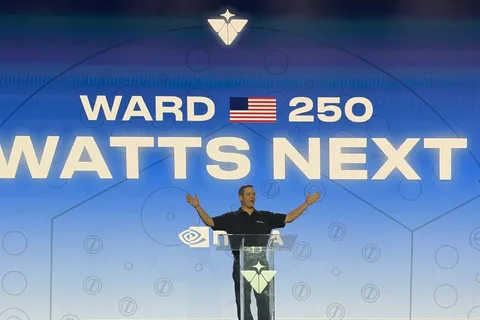
ORANGEVILLE — Hundreds gathered Wednesday at the San Rafael Energy Research Center property as Valar Atomics announced a major nuclear milestone that placed Emery County at the center of the nation’s growing push for advanced nuclear power and artificial intelligence. The event, called “Watts Next?,” brought together state officials, investors, local officials, government representatives, construction workers, caterers, Valar employees and community members for a high-energy celebration of the company’s Ward 250 reactor reaching criticality. Criticality is the point at which a nuclear reactor sustains a controlled chain reaction. For Valar, the announcement marked a significant step forward in proving that advanced nuclear technology can be developed and deployed faster than many traditional energy projects. Jess Housekeeper, Valar’s director of Utah operations and an Emery County native, opened the event by announcing that the reactor was officially critical and operating just yards away. His role in the project added a local connection to a milestone with national implications. Housekeeper thanked the contractors, vendors and construction crews who helped transform the project from blueprints into a working facility. He also thanked Emery County residents for welcoming the company and trusting Valar as it built a nuclear site in the community. That local support was a major theme throughout the event. Valar officials said the company has hired approximately 50 local employees, not including contractors, as part of its work in Emery County. For many in attendance, the event carried a sense of pride that went beyond the technology itself. The room was patriotic and energetic, with speakers and attendees celebrating Emery County’s role in helping lead the country into a new era of nuclear power, artificial intelligence and energy innovation. Valar founder and CEO Isaiah Taylor said the company was built around a belief that nuclear reactors should be developed with a focus on simplicity, safety and hardware execution. Taylor said nuclear energy will be essential in the coming decades because of its ability to provide reliable, around-the-clock power with a small environmental footprint. Company officials said Valar developed its Ward Zero prototype in 10 months with a team of 20 people and less than $20 million. The company later advanced to the Ward 250 reactor, which officials said was turned on nine months after breaking ground in September. The Ward 250 is a 100-kilowatt generator that uses a pressurized helium cooling loop to remove thermal energy, which is then converted into electricity through a thermoelectric generator. Company officials said the system represents the kind of compact, reliable power source that could help support future industry, manufacturing and computing needs. A major announcement during the event centered on Valar’s work with Nvidia. Max Ukropina, Valar’s head of projects, and representatives from Nvidia discussed a collaboration to explore nuclear-powered AI factories, including a proposed first-of-its-kind 30-megawatt facility in Emery County. The partnership directly addresses one of the biggest concerns surrounding data centers in the West, water use. Company officials said many traditional data centers rely on evaporative cooling, while newer Nvidia systems can use liquid cooling and dry radiators to reject heat without active water use. When paired with Valar’s helium-cooled reactor, officials said the technology could allow major AI infrastructure to be built in drought-prone areas without placing the same kind of demand on local water supplies. They also said a large, steady customer such as an AI factory could help spread fixed grid costs and potentially support lower local electricity prices over time. The water issue is especially important in Emery County, where new industrial projects are often judged not only by their economic potential, but also by their impact on limited local resources. Valar officials presented the nuclear and AI partnership as a way to bring major technology investment to the area while keeping water use low. State and federal leaders also spoke in support of the project, framing Emery County as an important part of America’s energy future. Speakers said the area’s long history of coal production has already made it an energy leader and that advanced nuclear technology gives the county a chance to remain central to the next generation of energy production. State Sen. David Hinkins spoke about his own history with Orangeville and Emery County, tying the milestone to the area’s long-standing role in energy production. Hinkins thanked the Utah Legislature and the Community Impact Board for helping support the project in a way that prevented the cost from being placed on local taxpayers. His remarks connected the celebration to a broader local concern: making sure major economic development projects benefit the area without creating an added burden for residents. For a county that has long helped power Utah through coal, Hinkins said the project showed Emery County can continue to be a leader as energy technology changes. The event ended with a live demonstration, presented in the form of a skit, that connected nuclear power and artificial intelligence in real time. Company officials used an Nvidia server to host a website about nuclear energy, with the server powered directly by the Ward 250 reactor located just yards away. During the demonstration, the reactor was raised to 37% power to provide electricity for the server hosting nuclearwebsite.com. Taylor explained that the website was being served directly from the reactor, meaning it would go offline if the reactor turned off. Company officials said the demonstration marked the first time in history that a private nuclear startup produced nuclear electricity and used it to directly power artificial intelligence infrastructure. The moment showed the practical connection between advanced nuclear power and the growing energy demands of AI technology. For Emery County and Orangeville, the milestone represented more than a company announcement. It was a moment of local pride, with a rural energy-producing community playing a visible role in a national effort to develop new nuclear technology and power the growing demands of artificial intelligence. Valar’s presence also signals a potential economic shift for the area. With local workers already hired, contractors involved and national attention turning toward the San Rafael Energy Research Center, supporters said the project could help Emery County build on its energy heritage while opening the door to new industries. The celebration made clear that Valar sees Emery County not only as a test site, but as a home for its work in Utah. Local leaders and company officials said the milestone shows that advanced nuclear energy does not have to be decades away and that Emery County can help prove what the next chapter of American energy can look like.
Source: etvnews.com