



By Emily Shugerman
Jun 15, 2026
Four big takeaways from The Standard’s billionaire tax investigation
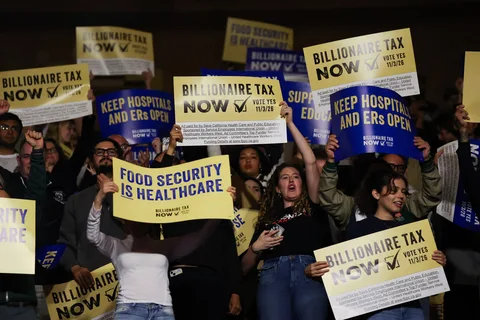
The elites of Silicon Valley are not taking the proposed billionaire tax lying down. The Standard reported over the weekend on a loosely coordinated effort by dozens of wealthy Californians to defeat an initiative that would level a one-time 5% tax on their entire net worth. The effort has included secret Signal chats, splinter groups, and plenty of infighting. The Billionaire Tax Act, proposed by healthcare union SEIU-UHW, has become a lightning rod in state politics, exacerbating tensions between the tech industry and organized labor. The ballot initiative is designed to restore healthcare funding decimated by the Trump administration, but opponents say it could drive tax-paying billionaires out of the state and unfairly target entrepreneurs and investors who hold voting shares in private companies. The measure has submitted nearly double the amount of signatures required to qualify for the ballot. It will now go to a public vote in November, unless the state Legislature proposes compromise legislation that satisfies SEIU-UHW enough to pull it from the ballot. Gov. Gavin Newsom is reported to be working closely on the effort to reach a legislative solution. Behind all these political machinations is a well-funded billionaire (and almost-billionaire) campaign to defeat the tax and keep unions from proposing such audacious measures in the future. Here are our four key takeaways about that fight. The campaign started in a secret Signal chat Dozens of members of the tech elite gathered in a group chat on the private messaging app this fall, when news of the proposed tax broke. The main activity in the group was “kvetching,” one person who’d seen the chat said, but it also served as a space to float possible counter-offensives. Among the proposed solutions, according to this person: Buying the company the labor union was using to collect signatures and prohibiting it from collecting any more. Members of the chat included a who’s-who of Silicon Valley, whose levels of participation varied, according to two people who saw it: Google cofounder Sergey Brin, venture capitalist Marc Andreessen, former Zynga CEO Mark Pincus, former Sequoia Capital head and chairman of The Standard Michael Moritz, Y Combinator CEO Garry Tan, PayPal cofounder Max Levchin, Sequoia partner Shaun Maguire, Stripe CEO Patrick Collison, Ripple cofounder Chris Larsen, Coinbase CEO Brian Armstrong, venture capitalist Ron Conway, Greenoaks Capital founder Neil Mehta, investor and “All-In” podcast cohost David Friedberg, and Future Ventures founder Steve Jurvetson and his wife, Genevieve. Some tech titans plotted to overthrow a congressmember who supported the tax When five-term Rep. Ro Khanna in December tweeted about his support of the tax — and his disdain for the billionaires opposing it — some among the tech set started looking for his replacement. Evan Low, a former California assemblymember and CEO of the LGBTQ+ Victory Fund, said he was approached by tech founders and venture capitalists who promised him “upward of $15 million” in campaign funding if he decided to run against Khanna. He declined. As The New York Times (opens in new tab) reported, foes of Khanna — who was once the recipient of donations from Andreessen and former Google CEO Eric Schmidt — also unsuccessfully appealed to San Jose Mayor Matt Mahan and venture capitalist Eric Jones. (Mahan opted to run for governor; Jones is running for Congress in California’s 4th District.) Chaos and infighting: Inside the implosion of Matt Mahan’s governor’s race The donors ultimately found a willing candidate in Ethan Agarwal, a startup founder and political unknown running a long-shot campaign for governor. After meeting with a group of Silicon Valley stars, Agarwal agreed to challenge Khanna in the June 2 primary and began raking in donations from the likes of Tan, Armstrong, Conway, and venture capitalist Blake Byers. The tech money accomplished little: Agarwal earned just 6.5% of the vote in the primary, coming in fourth, behind Khanna and two Republicans. The defeat caused Cooper Teboe, Khanna’s chief strategist, to say of the billionaire donors: “Many of them are bold, and their tactics are stupid. They’re trying to deploy the same tactics they’ve used in business into politics. None of it has worked, because they don’t know what they’re doing.” Tax-haters started so many opposition groups, they couldn’t keep them straight The announcement of the Billionaire Tax Act, and SEIU-UHW’s aggressive drive to gather signatures, prompted tech billionaires to fund a flurry of new political groups to oppose the measure. At one point, two donors were so overwhelmed by the options that they proposed a Zoom call at which representatives of each group would pitch their organization, while donors watched with their screens blacked out for privacy. The idea was eventually scrapped for fear that details of the call would leak to the press. Some of the groups struggled to get off the ground because of all the competition. Stop the Squeeze, a project of two Newsom consultants, garnered an early $100,000 check from Conway but failed to raise much more, in part because of distrust of Newsom among the billionaire class. Meanwhile, tech executives reached out to consultants for crypto PAC Fairshake about launching Golden State Promise, but only one — Larsen — ultimately donated. (A representative said the group plans to raise more as the campaign progresses.) The billionaire consensus has settled around one PAC After a rocky six months or so, many billionaires seem to have coalesced around the pressure group led by Sacramento strategist Ned Wigglesworth. Building a Better California has never taken an explicit stance against the Billionaire Tax Act but did sponsor three initiatives that would nullify the tax if it is passed. Two of those measures have submitted enough signatures to qualify for the ballot, in part because of the group’s willingness to pay signature gatherers upward of $15 per John Hancock. Donors to the group include Brin, who has given a whopping $66 million, along with Moritz, Collison, DoorDash CEO Tony Xu, and venture capitalist John Doerr. One insider said Building a Better California had “captured the hearts and minds of the billionaire class” by delivering on the counter-initiatives — and could be setting itself up for the long game. “We’re going to have a new political era with a new governor and with all these billionaires [involved],” this person said. “If there’s a way that [Building a Better California] can make this permanent, they have now solidified their real estate in the new political world.”
Source: The San Francisco Standard