



Humanoid Robots Are Fashion’s Future Clients. Hansae Is Getting Ready to Dress Them.
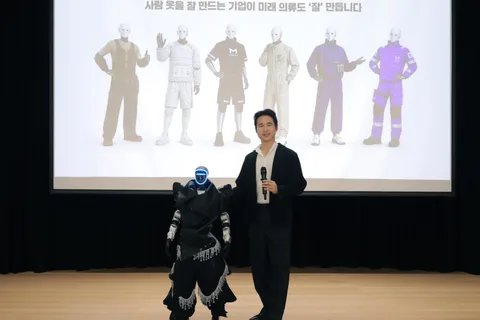
Hansae has built its reputation on getting there first. The South Korea-based manufacturer—one of the world’s largest apparel producers that makes garments for global brands including Gap, Carhartt, Target and Walmart—was an early mover in 3D virtual design, then in AI-driven product development. Now Hansae is applying that same pioneering instinct to a question few in the industry have thought to ask: When humanoid robots enter our homes and workplaces, what will they wear? On June 8, the company offered its answer with “Wear the Future,” staged at the Textile Center in Seoul, which was billed as Korea’s first exhibition of apparel designed for humanoid robots. Hansae laid out a research vision for an emerging category—framing robot apparel not as novelty, but as the next frontier for a company that has spent decades turning functional needs into wearable solutions. An innovation-first company reads the next signal For Hansae, the move follows a clear through-line. “Innovation has always been part of Hansae’s DNA—we have consistently been the first to try what others haven’t,” said Daymond Ik Whan Kim, vice chairman and CEO of Hansae. “We were first to build a dedicated 3D design capability, and then to embed AI across our process. Preparing for the humanoid era is the natural next step.” That progression is more than rhetoric. Hansae established Korea’s first dedicated virtual design organization in the apparel industry in 2019, adopting 3D virtual-sampling technology that let it move faster than peers—an advantage that proved advantageous through the disruptions of the pandemic. In 2023, it stood up a dedicated AI team, whose work is now woven through planning, design and development. Today the company employs roughly 140 designers and technicians across global hubs including Seoul, New York and Barcelona, and it treats each technological shift as a chance to extend what functional clothing can do. The humanoid opportunity fits that pattern. As the global technology industry moves beyond generative AI into a race to build humanoid robots—with players such as Nvidia, Tesla, Boston Dynamics, Figure AI and Agility Robotics positioning the field as a next-generation growth industry—Hansae sees a coming inflection point for apparel itself. As robots take on roles across education, caregiving, manufacturing and services, the company expects an entirely new spectrum of clothing needs to follow. Reinterpreting functional expertise for a new kind of body Central to Hansae’s thesis is a reframing led by its R&D organization: that robot apparel is not a departure from the company’s core competence, but a direct extension of it. “Clothing for humanoids isn’t an entirely new domain—it’s a reinterpretation of the functional-apparel expertise we’ve developed for people, adapted to a new environment,” said Ji Yeon Shon, a director in Hansae’s R&D division. “A humanoid resembles a person but is built differently. Once you account for batteries, sensors, joint structure and heat management, the design approach has to be fundamentally rethought.” Shon points to Hansae’s accumulated capabilities—cooling and heat-dispersion materials, high-stretch and high-durability fabrics, lightweight construction—as the foundation for that reinterpretation. The exhibition pieces preserve a recognizably human silhouette while being re-engineered around a robotic frame: Cooling channels and mesh ventilation route around drive units and batteries to manage the heat of long operation; abrasion-resistant, water-resistant fabrics hold their shape through continuous use; joints at the shoulder, elbow and knee are left open or built from high-stretch material for full range of motion; and deliberate openings keep cameras and sensors unobstructed. Because a robot cannot yet dress itself, zippers, snaps, magnets and detachable modular pieces make each garment easy to put on, remove and maintain. A vision made tangible The exhibition translated that design philosophy into two key use cases. On one side were solutions for humanoids designed to live closely alongside people, with companion concepts such as Hearty—an emotional-support robot in soft knits with a gentle “hug pressure” feature—alongside caregiving, sleep and child-companion designs built to feel familiar and reassuring. On the other were work uniforms engineered for humanoids on industrial sites, spanning hazardous operations, smart farming, fitness coaching and auto maintenance. Hansae’s Hearty concept for “Wear the Future” Courtesy of Hansae The collection was co-developed by Hansae and affiliate Hansae MK, the fashion arm of parent Hansae Yes24 Holdings. Hansae MK contributed through its new brand The B Archive—rooted in the heritage of its denim label Buckaroo—which brought a street-vintage sensibility and original artwork to the concepts, demonstrating that robot apparel can carry genuine design identity, not just technical function. Hansae’s gardening robot concept for “Wear the Future” Courtesy of Hansae Preparing for a market before it arrives Market researchers expect the humanoid sector to grow into the hundreds of billions of dollars over the coming decades, and Hansae is candid that robot apparel remains at the research stage, with commercialization still to come. Its intent is to be ready ahead of that curve. The company has already begun engaging humanoid manufacturers and materials startups, and it plans to develop “Wear the Future” into a standing platform for future-apparel research rather than treating it as a one-off showcase. It is a characteristically forward-looking position for a company that has spent years reshaping itself from a producer into a design- and technology-led partner. “Humanoid fashion is a future no one has yet pioneered,” Kim said. “A company that makes clothing well for people can make it well for humanoids—and we intend to lead that future.
Source: WWD