



In the humanoid robot industry, joint unions between robot hardware companies and artificial intelli..
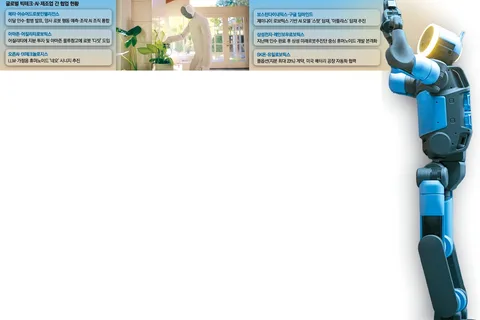
A view of Boston Dynamics' humanoid Atlas working in a factory. Boston Dynamics In the humanoid robot industry, joint unions between robot hardware companies and artificial intelligence (AI) companies are increasing. If the Generative AI industry is a software war centered on large-scale language models (LLM), the humanoid industry is important for both AI, the brain of robots, and machines, which are the body, and the combination of the two will eventually determine the winner of the robot industry. A symbolic example of this trend is Boston, an affiliate of Hyundai Motor GroupIt's a collaboration between Imix and Google DeepMind. The plan is to increase the robot's ability to perform autonomous judgment and work by combining Google DeepMind's large-scale behavioral learning model and reinforcement learning technology with the world's best dynamic design and balance control technology accumulated by Boston Dynamics. Last month, Boston Dynamics released a video of its four-legged walking robot "Spot" carrying Google Gemini to carry out its mission. Spot checked the to-do list on the blackboard using a camera and a Gemini, and then went outside to take his dog on a leash when "walking the dog" was added. The level has been raised to the point that robots understand complex industrial sites and act autonomously. ◆ Spread the concept of 'software defined robot' In this background, there is a concept called "Software Defined Robot (SDR)." After building a general-purpose hardware platform, it expands functions only with software updates. Just as smartphones gain new functions through operating system (OS) updates, robots are also structured to evolve performance through wireless communication network updates (OTA) without replacing hardware. The problem is that there is a limit to optimization for hardware companies to design such general-purpose robots independently or AI companies to develop and apply only software. Humanoids can be optimized for performance only when the sensor, actuator, reducer, battery, and controller structures are closely aligned with the AI model design. In the end, it means that AI learning should be considered from the hardware design stage. Such cooperation can be a win-win for AI companies as they can secure robot hardware customers to use their AI, and robot companies can develop hardware optimized for the platform. ◆ The robot industry such as Samsung and SK is taking a step forward Samsung Electronics secured the largest shareholder status of Rainbow Robotics last year and began developing humanoids in earnest, centering on the Future Robotics Promotion Team. Rainbow Robotics has strengths in two-arm cooperative robots and precision drive control technology. Rainbow Robotics will conduct a government task to develop humanoid robots specializing in display processes based on AI foundation models by 2028. Analysts say that Samsung Electronics will secure vast amounts of physical data generated at industrial sites and learn robots based on them to enable rapid advancement. SK On, a battery affiliate of SK Group, signed a call option contract with Ilgi Robotics, an industrial robot company, to lay the foundation for entering the manufacturing automation and robot business. Only Robotics is expected to cooperate in automation of SK-on U.S. battery plants. Only Robotics plans to break away from the "sequence method" in which AI is installed from its cooperative robots to carry out control steps sequentially according to a set order or condition, enabling flexible control of similar situations. LG CNS has embarked on the development of humanoid intelligence with Skilled AI in the United States. Skilled AI is a robot foundation model company that focuses on AI models and simulation learning systems. It trains hundreds of millions of times of virtual interaction data in its own simulation environment and is developing a general-purpose control model called "skilled brain." ◆ Big tech overseas made aggressive investments Acquisitions and strategic alliances are also active overseas. Earlier this month, Meta acquired Ashud Robot Intelligence (ARI), an AI startup for humanoid robots in the United States. With this acquisition, more than 20 employees of ARI will join the research department of Meta's AI division, Meta Superintelligence Research Center. ARI has been developing a foundation model for humanoid robots that can perform various physical tasks, including housework. OpenAI led a series A2 investment in humanoid development startup 1X Technologies in 2023. As an open AI, X1's humanoid model "NEO" can collect video and behavioral data obtained by moving in real life, and X1 can quickly advance its physical AI capabilities by utilizing top-level AI technology. Amazon acquired Fauna Robotics, a U.S. humanoid startup, in March. Fauna Robotics is focused on developing home humanoid robots. Amazon is also investing in logistics automation humanoids. Amazon, which invested in Agility Robotics in the U.S. in 2022, has put the humanoid "Digit" into its logistics warehouse as a pilot since the following year. Among them, Tesla is strengthening its vertical integration strategy through internalization. This is possible because Tesla, unlike other AI and robot companies, has already secured key pipelines for humanoid development such as AI, manufacturing, data collection, and battery integration technologies.
Source: 매일경제