



By Apoorva Anand
Jun 20, 2026
The Great IIT Reversal: Why are toppers choosing Civil Engineering over AI?
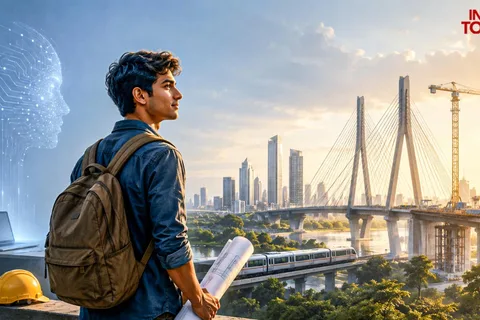
For nearly a decade, the script seemed unchangeable. The highest JEE ranks chased Computer Science. Parents proudly celebrated coveted CSE seats at IIT Bombay and IIT Delhi. Startup success stories dominated social media, while crore-plus placement packages became national headlines. The hierarchy seemed settled: Computer Science first, everything else later. Branches such as Electrical, Mechanical and Civil Engineering remained respected, but few could rival the allure of CSE. Meanwhile, Civil Engineering, once among India's most respected engineering disciplines, slipped steadily down students' preference lists. The future, everyone assumed, belonged to code. But beneath the familiar scramble for IIT seats, a deeper debate is taking shape: in the age of AI, what does a future-proof engineering career really look like? As Artificial Intelligence reshapes the software industry and raises questions about the future of entry-level coding jobs, India is simultaneously embarking on one of its biggest infrastructure pushes in decades. New expressways, metro networks, high-speed rail corridors, renewable energy projects and smart cities are transforming the country's landscape. At the intersection of these two trends, a surprising development is emerging. Civil Engineering is once again attracting the attention of some of India's brightest JEE aspirants. Computer Science remains the undisputed king of IIT admissions. But for the first time in years, the conversation around engineering careers is beginning to change, and that may become one of the most intriguing stories of the 2026 admission season. India's infrastructure boom meets changing IIT preferences THE NUMBERS THAT SPARKED THE DEBATE The first round of IIT admissions has thrown up a surprising trend. Then came the numbers. At IIT Bombay, Civil Engineering attracted candidates with opening ranks as high as 385, compared with 2,666 a year earlier. IIT Delhi witnessed an even steeper shift, with the opening rank climbing from 3,030 to 179. Similar trends at IIT Roorkee and IIT Bhubaneswar hinted that something unusual was unfolding in this year's admission cycle. The numbers do not point to a mass exodus from Computer Science. But they do suggest that a growing number of high-performing students are reassessing assumptions that once seemed unquestionable. A growing number of academically strong students are making choices that are less driven by conventional wisdom and more by long-term career calculations. "JoSAA 2026 Round 1 data tells a clear story. CSE at IIT Bombay closed around AIR 65, while Civil closed past 4,300. Nearly every top-100 ranker still picks Computer Science," says Dr Saurabh Kumar, CEO and Founder of Shiksha Nation. "What we're witnessing is not a mass migration from silicon to cement. The more interesting story is that students beyond the top 100 ranks are making more deliberate and less herd-driven choices," Saurabh Kumara adds. That distinction matters. The story of 2026 is not that Computer Science is losing its crown. It is that students are beginning to ask harder questions about the future. Civil Engineering returns to the spotlight as high-ranking IIT aspirants rethink long-held career assumptions. WHEN AI STARTED CHANGING MINDS For years, Computer Science enjoyed an aura of certainty. The formula seemed simple: secure a CSE seat, graduate into a booming software industry, and access some of the highest-paying jobs available to young professionals in India. But certainty is becoming harder to find. The rapid rise of generative AI has introduced a new variable into the equation. Tools capable of writing code, debugging software and automating routine programming tasks have forced students to confront a question that barely existed a few years ago. What happens when machines start doing some of the work that junior software engineers once performed? "AI is automating exactly the entry-level coding work that made CSE a guaranteed ticket. For the first time in a decade, the assumption that CSE automatically guarantees career security is being questioned," says Dr Kumar. Recent fluctuations in technology hiring have further amplified those concerns. The software industry remains enormous and continues to offer exceptional opportunities. Yet students are increasingly aware that the path ahead may not be as straightforward as it once appeared. For many aspirants, the conversation is no longer about the highest starting salary. It is about long-term relevance. THE BIGGEST CONSTRUCTION SITE IN THE WORLD While technology careers are undergoing transformation, India's infrastructure story is entering a defining phase. The country is investing heavily in highways, metro rail systems, logistics corridors, airports, renewable energy projects, industrial hubs and urban development programmes. From the Delhi-Mumbai Expressway to new metro networks and green energy corridors, the scale of construction is unprecedented. For civil engineers, that translates into opportunity. "India's infrastructure push is creating stronger visibility for core engineering careers. Students are aware that AI is reshaping entry-level technology roles, while physical infrastructure, sustainability, urbanisation and public investment are creating long-cycle demand," says Shantanu Rooj, Founder and CEO of TeamLease Edtech. The image of Civil Engineering itself is changing. Today's civil engineers are as likely to work with data analytics, digital twins, Geographic Information Systems (GIS), sustainability models and AI-powered planning tools as they are with concrete and steel. The discipline is increasingly becoming a fusion of engineering, technology and environmental science. From concrete to code: Modern civil engineers are combining traditional engineering with AI, data analytics and sustainability tools. CIVIL ENGINEERING ISN'T WHAT IT USED TO BE Part of the renewed interest stems from the fact that civil engineering education itself is evolving. The transformation is visible inside IIT classrooms. At IIT Bombay, Civil Engineering students, particularly through the Centre for Studies in Resources Engineering (CSRE), can take courses such as Machine Learning for Remote Sensing, exposing them to the growing intersection of infrastructure, geospatial technologies and artificial intelligence. At IIT Hyderabad, students study subjects such as Remote Sensing and GIS Applications to Civil Engineering, while the institute's focus on future transportation systems is reflected in programmes like Smart Mobility. These offerings highlight a broader shift underway across IITs. Civil Engineering is no longer confined to concrete, steel and construction sites. Increasingly, it combines data science, AI, geospatial analytics, sustainability and urban planning to address some of the most complex infrastructure challenges of the 21st century. As infrastructure becomes smarter, greener and more data-driven, tomorrow's civil engineers will help design intelligent transportation systems, climate-resilient cities and sustainable urban ecosystems. The line between core engineering and technology is becoming increasingly blurred. RS 40 LAKH TODAY OR RELEVANCE FOR 40 YEARS? For much of the last decade, branch selection often revolved around one number: placement package. That calculation is becoming more nuanced. Computer Science graduates from top IITs routinely secure salaries between Rs 20 lakh and Rs 40 lakh annually, with some international offers stretching much higher. Civil Engineering graduates start lower, with average salaries at leading IITs typically around Rs 8 lakh per annum. Yet students are beginning to evaluate a broader set of trade-offs. Technology careers often move at extraordinary speed, with product cycles measured in months. Infrastructure projects, by contrast, frequently span decades. Government-backed sectors such as railways, urban infrastructure, water management and public works offer a different kind of career trajectory, one often associated with long-term stability. According to Professor Vivek Pancholi, Faculty In-Charge (Placement), IIT Roorkee, students are increasingly considering factors beyond immediate salary. "The choice of branches reflects changing perceptions regarding career opportunities. Students appear to be considering long-term career opportunities, research prospects, higher studies and growth potential in core engineering sectors such as manufacturing, construction, FMCG and sustainability, says IIT Roorkee Professor Vivek Pancholi. "Placement trends are one factor, but not the only factor influencing these decisions," he adds. Climate-related careers have further strengthened the appeal of core disciplines. Environmental engineering, transportation systems, water resource management and sustainable construction are emerging as globally relevant fields. For students seeking meaningful work tied to some of the century's biggest challenges, Civil Engineering offers a direct pathway. THE IIT BRAND IS MATTERING AGAIN Another subtle shift is visible in how students are evaluating institutions. For years, many aspirants preferred Computer Science at newer IITs over core branches at older and more established campuses. That equation may be changing. Experts say a growing number of students are willing to choose a core branch at IIT Bombay, IIT Delhi or IIT Madras because they value the ecosystem, alumni network, research opportunities and peer group. "The AIR 2,000 to 15,000 band is where the real story lies," says Dr Kumar. "Students in this range are increasingly willing to take a core branch at a top-three IIT rather than CSE at a newer IIT. They're placing greater value on the institute and peer network than on the branch label alone," Dr Kumar explains. For many IIT aspirants, the institute's legacy, alumni network and ecosystem are once again outweighing branch preferences. The top rankers continue to overwhelmingly choose Computer Science. But among the broader pool of high-performing students, the hierarchy of choices appears less rigid than before. A GLOBAL TREND, NOT JUST AN INDIAN STORY India is not alone in witnessing renewed interest in core engineering. The United States has launched one of its largest infrastructure investment programmes in decades through the Infrastructure Investment and Jobs Act. Across Europe, the Green Deal is driving investments in sustainable transportation, energy systems and climate-resilient infrastructure. China's infrastructure boom created an entire generation of engineers who built the world's largest high-speed rail network, expanded metro systems across dozens of cities and transformed urban landscapes at an unprecedented scale. The lesson is clear. When nations invest heavily in physical infrastructure, demand for engineering talent follows. India's current trajectory suggests a similar possibility. EARLY SIGNAL OR THE START OF SOMETHING BIGGER? Experts remain cautious about declaring a permanent shift. Admission trends can be influenced by placement reports, counselling advice and changing perceptions from one year to the next. "It may be viewed as part of evolving student preferences rather than a fixed trend," says Professor Pancholi. "Every admission cycle reflects a mix of choices, with academically strong students opting for core engineering disciplines based on their interests, aptitude and long-term career plans." Shantanu Rooj offers a similar assessment. "It is safer to treat this as an early signal rather than a settled trend. One or two admission cycles can be influenced by counselling behaviour, institute preference and media narratives around AI and tech hiring," Professor Pancholi adds. Yet both agree that the underlying forces driving the conversation are real. India's sustained investments in infrastructure, manufacturing, energy transition and urban systems are reshaping the employment landscape. At the same time, core engineering disciplines are becoming increasingly technology-intensive. "If IITs continue modernising core branches with AI, analytics, sustainability and industry-linked projects, the conversation may shift from 'core versus tech' to 'core engineering powered by technology'," Professor Pancholi further explains. A changing job market is forcing students to rethink old assumptions. THE BIGGER STORY Perhaps the most important takeaway from the 2026 admission season has little to do with Civil Engineering itself. The deeper story is about how India's brightest students are thinking about the future. For years, engineering choices were often driven by the next placement season. Increasingly, students are asking a different question. Where will India be in 2040? Will the next generation of opportunity emerge only from software platforms and algorithms? Or will it also come from building the roads, railways, energy systems, water networks and cities that support a rapidly developing nation? The real shift is not from coding to construction. It is from short-term opportunity to long-term conviction. Computer Science remains India's most sought-after engineering discipline and is likely to remain so for years to come. But the growing interest in Civil Engineering suggests something important is changing. In the age of Artificial Intelligence, some of India's brightest young minds are no longer asking only what technology can build. They are also asking who will build the nation itself. And for a growing number of IIT aspirants, the answer may begin with Civil Engineering.
Source: India Today
მსგავსი სტატიები
-
 Two ex-OpenAI founders built a tool to measure how well AI models actually know who you are
Jun 20, 2026
Two ex-OpenAI founders built a tool to measure how well AI models actually know who you are
Jun 20, 2026
-
 97 Incredible And Eye-Opening Facts That Reveal How Strange And Beautiful The World Really Is
Jun 20, 2026
97 Incredible And Eye-Opening Facts That Reveal How Strange And Beautiful The World Really Is
Jun 20, 2026
-
 Meet the SpaceX insiders Elon Musk trusts to run his $1.25 trillion empire
Jun 20, 2026
Meet the SpaceX insiders Elon Musk trusts to run his $1.25 trillion empire
Jun 20, 2026
-
Just now, a Nobel laureate has become a new employee of Anthropic Jun 20, 2026