



By Nate Erskine
Jun 15, 2026
The Market Crowned a Trillionaire and Caged the Boy It Trained | by Nate Erskine | Jun, 2026
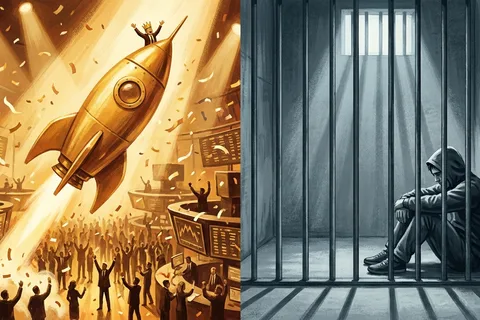
On Friday, June 12, 2026, two headlines sat stacked on top of each other in my LinkedIn feed. They weren’t a moral test, but they functioned as one. The first: SpaceX surged 19% in its Nasdaq debut, closing at a $2.1 trillion market cap and making Elon Musk the world’s first trillionaire. The second, directly beneath it: a federal appeals court rejected Sam Bankman-Fried’s bid to overturn his fraud conviction, leaving his 25-year sentence untouched. One man’s paper wealth was celebrated as the triumph of human innovation. The other will spend two decades in a cell. And here’s the detail almost nobody mentioned in the rush to canonize one and bury the other: the people Bankman-Fried supposedly ruined are getting their money back. All of it. Plus interest. I’ll give the celebration its strongest case, then show you why it’s the bait — why the boy in the cell and the man with the bell were built by the same machine, why both empires rest on the same fragile thing, and why only one of them was punished for it. And stay with me on this one because it a long read, but it’s needed to do it justice. The bull case — and why it’s the bait SpaceX is not a fake company. Anyone who calls it one is being lazy. In 2025 it flew 165 Falcon 9 missions — roughly 52% of every orbital launch on Earth — and Starlink crossed 10 million subscribers, bringing in about $11.4 billion of the company’s $18.7 billion in revenue. The launch-and-internet business is genuine, dominant, and hard to replicate. Here’s the problem. That real business cannot, on any sane multiple, explain a $2.1 trillion price. SpaceX trades at roughly 90 times sales; Tesla, no value stock, trades at about 14. Morningstar — the most mainstream research house there is, not a short shop — puts fair value at $63 a share. It closed Friday at $161, a figure Morningstar calls “significantly overvalued” by more than half. So where does the other trillion-plus come from? Not the rockets. It comes from three moves, and all three should make you nervous. One: he bought his own company. In February 2026, SpaceX absorbed xAI — Musk’s AI startup, maker of Grok — in a deal that lifted its private valuation to $1.25 trillion. Read that again: Musk, who controls SpaceX, bought a company he also controls, conjuring hundreds of billions in headline value out of his own left pocket paying his right. Morningstar flagged it plainly as a related-party transaction, not conducted at arm’s length. And the asset he merged in is the money-loser in the building: after absorbing xAI, SpaceX swung from a $791 million profit in 2024 to a $4.94 billion loss in 2025. Minority shareholders can do nothing — Musk keeps roughly 85% of the voting power. You’re not buying a vote; you’re buying a ticket to watch. Two: the revenue was signed weeks before the bell and can vanish in 90 days. In the weeks before the IPO, SpaceX disclosed two enormous compute contracts — Anthropic at $1.25 billion a month, Google at $920 million — together about $2.17 billion a month, more than $70 billion in headline aggregate. The Anthropic deal hit the S-1 on May 20, Google on June 5; the stock priced June 11. Now the clause nobody headlined: both contracts can be terminated on 90 days’ notice after December 31, 2026. The towering revenue line propping up a $2.1 trillion valuation was inked three weeks before the offering and is legally cancellable six months after it. Remember that escape hatch. Three: the revenue is circular, and the people saying so aren’t cranks. Jim Chanos — the short-seller who called Enron — said it out loud: “The company is not worth, in my opinion, $1.75 trillion based on any reasonable assumptions over the next five years.” His warning about the whole AI complex: “They’re putting money into money-losing companies in order for those companies to order their chips.” Nvidia funds the customers; the customers buy Nvidia; everyone rents capacity from everyone else, and revenue circulates in a way that looks like growth until someone asks for cash. On top of the loop sits the purest narrative asset of all — data centers in space. Chanos again: “We can build whatever stories we want — colonies on Mars, factory tunnels, data centers in space — to justify the valuation.” And the whole edifice is underwritten by a man with the worst delivery record in modern business. In 2016 Musk said a Tesla would drive itself coast-to-coast within a year. In 2019 he promised a million robotaxis by 2020. In 2026 the robotaxis that exist still ride with a human safety monitor in the front seat. “Next year” is practically a Musk product line. To be precise: I’m not saying Musk has committed a crime; I have no evidence he has, and a stretched valuation isn’t illegal. I’m saying something narrower — a company is forecasting a future, taking other people’s money against it, and being celebrated for the size of the promise rather than the substance of the delivery. Hold that. Now meet the man we jailed for playing it. The boy was not born a fraud. He was trained. Strip away the cartoon villain and look at how Sam Bankman-Fried was actually assembled. He left MIT with a physics degree in 2014 and walked into Jane Street Capital, one of the most respected quantitative trading firms on Earth. His interview wasn’t an ethics test; it was probability games with shifting rules, and he won by doing the one thing the firm prized — maximizing expected value, taking the bet whenever the math says the average outcome is positive, again and again. Jane Street paid him $300,000 his first year to make high-variance bets with the firm’s capital and feel nothing doing it. That is the job. That is what the most prestigious houses on Wall Street select and reward for. The second half of his wiring was installed at a 2012 lunch, where the Oxford philosopher William MacAskill pitched the precocious utilitarian on effective altruism: don’t work at a soup kitchen — get extremely rich, then give it all away. “Earning to give.” Bankman-Fried bought it whole and left to start Alameda and then FTX explicitly to make and give away as much money as possible. Get Nate Erskine’s stories in your inbox Join Medium for free to get updates from this writer. Remember me for faster sign in So here is what the system produced: a kid told by elite philosophers that accumulating a fortune was the highest moral act, trained by an elite firm to make relentless bets with capital that wasn’t his, then released into a market with no adult supervision. He didn’t wake up one morning and decide to defraud people. He was the finished product of a pipeline that taught him risk was a math problem and money was a tool for someone else’s good. The case for the conviction — told fairly None of that is a legal defense, and I won’t pretend it is. A jury convicted him on seven counts. This week the Second Circuit, unanimously, refused to disturb the verdict: “While he was publicly reassuring customers, investors and regulators that FTX customer funds were safe, he was simultaneously using FTX as his own personal piggy bank.” Customer deposits moved to Alameda and were spent on real estate, venture bets, and political donations. He told the world the money was safe while he was spending it. The comparison I’m about to make is stronger because it survives that. It wasn’t fraud that killed FTX. It was a run. Here’s what almost everyone forgets about how FTX actually died. On November 2, 2022, CoinDesk published a leaked balance sheet showing Bankman-Fried’s trading firm was propped up largely by FTT — the token FTX had printed itself. Four days later, Changpeng Zhao — “CZ,” head of Binance and the one major player who stood to gain from FTX’s death — tweeted that Binance would liquidate its entire FTT position. He barely hid the motive: “we won’t support people who lobby against other industry players behind their backs.” Binance had been an early FTX backer; Bankman-Fried bought CZ out, then lobbied Washington for rules CZ read as a knife aimed at him. One rival, one tweet, perfectly timed. What followed is the only thing that matters. $997 million walked out in 24 hours, roughly $6 billion over 72 — against the tens of millions FTX handled on a normal day. By November 8 it had frozen withdrawals; by November 11 it was bankrupt, an $8 billion hole where customer money should have been. But sit with the mechanism. Every bank on Earth is insolvent if all its depositors demand their money at once — that is what a bank is, a machine for borrowing short and lending long. FTX’s assets weren’t imaginary; they were illiquid: venture stakes, Solana, the Anthropic position. What turned a fragile structure into a 25-year felony wasn’t only what Bankman-Fried did with the money — it was that a rival with skin in the game struck the match, unhedged retail panicked, and the assets couldn’t be sold fast enough to meet the stampede. The fraud was real. But the thing that actually pulled the temple down was a collapse of confidence. And confidence is the most riggable asset in finance. The number nobody wants to sit with Every non-governmental FTX creditor is being repaid 100% of their claim — 118% to 119% with interest. The estate has already pushed out around $10 billion. The “victims” of the largest crypto fraud in history are, in dollar terms, being made more than whole. There’s a real asterisk: claims were frozen at November 2022 dollar values, so someone who deposited one bitcoin gets the ~$17,000 it was worth that day plus interest, not the ~$69,000 it trades at now. Those creditors are right to be angry about the upside they lost. But notice what the asterisk concedes — the only reason there’s “lost upside” to argue about is that the recovered assets exploded in value. The hole was never permanent. It was a liquidity mismatch that detonated under a run — exactly the kind a central bank would paper over with an emergency loan for a regulated bank, and nobody would call it a crime. And here’s what should end the argument about who the careful adults really are. In 2021, FTX put $500 million into a then-obscure AI lab called Anthropic for about 8%. The estate’s lawyers — the prudent ones, the system’s trusted grown-ups — sold that stake during bankruptcy for between $884 million and $1.3 billion. Anthropic is now valued at roughly $380 billion; that same 8% would be worth about $30 billion today. The professionals liquidating FTX vaporized more potential value in a single careful sale than Bankman-Fried is even accused of misappropriating — by the book, billing hourly, and no one is going to prison for it. The same Anthropic now rents compute back to Musk’s machine at $1.25 billion a month, helping float Friday’s trillionaire. Where’s the difference? Put the two side by side and ask the only question that matters: what separates the celebrated bet from the criminal one? Start with consent. FTX’s investors were the opposite of helpless — Sequoia, SoftBank, BlackRock, Temasek, Ontario Teachers’ — sophisticated, accredited money that knew it was buying a three-year-old crypto exchange run by a 29-year-old in shorts. They priced the risk and chose it. When a bet like that fails, the polite word in every other context is “loss,” not “fraud.” Now look at who’s exposed to SpaceX. To get Musk’s company into the Nasdaq-100 on day fifteen, Nasdaq rewrote its own rulebook — a methodology effective May 1, 2026 admits any newly listed top-40 company after 15 trading days, and the prior free-float requirement was simply deleted. The result: passive funds are forced to buy an estimated $8 billion of SpaceX in the first month alone, up to $30 billion in total, by selling down Apple, Microsoft, and Nvidia to make room. Roughly $1.4 trillion tracks that index — through 401(k)s, target-date funds, annuities, and the pensions of teachers and firefighters who never heard a pitch, never read the S-1, and never got to say no. Only 3% to 4% of the shares are even freely tradable. So where’s the difference? Bankman-Fried took bets from professionals paid to evaluate them and lost — and they’re being repaid with interest. Musk’s valuation is being injected, by rule change, into the savings of working people who were never asked. One is a crime. The other is Friday’s celebration. Now run the same play on SpaceX Here’s the part that should keep someone at the SEC awake. A $2.1 trillion company with only 3–4% of its shares actually trading is not a fortress. It’s FTX’s structure in a tuxedo — a towering valuation balanced on a sliver of float and held aloft by everyone with a reason to keep it there: the banks that underwrote it, the early VCs sitting on 1,000x, the index funds legally compelled to buy, and Musk himself, who merged his own loss-making lab in to manufacture the number. Right now they’re all pointing the same way, because everyone with skin in the game is long. That is precisely the configuration FTT had at its peak — right up until it wasn’t. So ask the FTX question of SpaceX: what’s the tweet? It doesn’t take a fraud to start a run; it takes a crack in the story. A Starship slip. An xAI cash-burn disclosure nobody can spin. Or — recall trick two — those compute contracts going cancellable after December 31, and Google or Anthropic quietly handing in 90 days’ notice. On a 3–4% float, confidence doesn’t ease lower; it gaps. And when it does, the bag isn’t held by hedged VCs who chose the table — it’s held by a teacher’s pension fund marched there in handcuffs by an index rule. Here is where the law gets interesting, because the law is written by the winners. The same illiquidity-plus-self-dealing that earned Bankman-Fried 25 years only became “fraud” once the chart collapsed and the shortfall was exposed. Reverse the timeline and the labels follow the price. Run SpaceX’s mechanics past a judge from the losing side, after a crash, the way a courtroom would: a founder who bought a company from himself to inflate the mark, booked cancellable revenue timed to the offering, kept 85% of the votes so no one could stop him, paid himself a trillion on paper — while the public’s retirement savings, force-fed in by a rewritten rule, evaporated. To be clear, that is a thought experiment, not an allegation; Musk has been charged with nothing and a high valuation is not a crime. But notice how little the conduct has to change for the word to change. All that has to move is the share price. Winners write the history. Losers get the indictment. What the two headlines actually teach That doesn’t excuse the fraud. You cannot spend customers’ money and tell them it’s safe, however good your intentions, and the jury was right to say so. But 25 years — longer than many sentences for violent crime, for a first offense whose creditors ended up over-compensated, with an appeals court this week refusing to soften a single year of it, in the same week the market
Source: DataDrivenInvestor