



By News Desk
Jun 16, 2026
The Race for Survival of Unitree Robotics and Its Peers
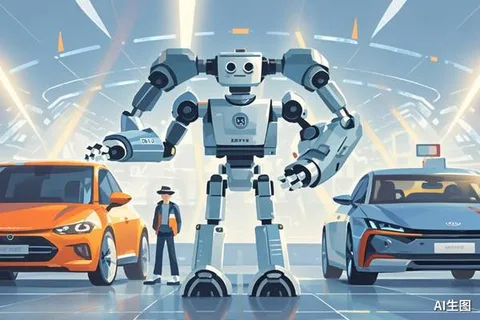
While startups like Unitree and Ubtech are surging ahead in the robotics track, automakers such as XPeng and Li Auto are entering the field across industries, relying on similar technologies, extensive channels, and substantial cash reserves. A "full - scale war" between the two sides is about to break out, and the window of opportunity for Unitree and its peers to break through is extremely urgent. Over the past few years, startups like Unitree, Ubtech, and Songyan Power have always been the main players in the domestic robotics track. As pioneers, they have completed the verification of product commercialization and are also the core promoters of the current industry's technical standards, product pricing, and overseas market expansion. However, a much larger cross - industry force is approaching at full speed. Star automakers like XPeng and Li Auto are aggressively entering the robotics track, relying on the highly similar technical foundation of smart cars and humanoid robots, a more mature marketing system, and more abundant capital reserves. In this situation, the window period for startups like Unitree and Ubtech to build their moats is rapidly shrinking, and a race related to survival and industry discourse power has already begun. 01 Unitree and its peers have just established their territory when automakers come to "invade" Thanks to the first - mover advantage, Unitree and its peers have initially divided their territory in this track. The player with the largest territory is undoubtedly the leading company, Unitree. Last year, the company shipped 5,511 units, topping the global robot sales list. It also holds a leading position in scientific research, education, and inspection markets. At the same time, it launched the G1 model priced at 99,000 yuan to try to expand the consumer (C - end) market. Ubtech, known as the "first humanoid robot stock in Hong Kong," has initially established its barriers in the industrial scenario. In 2025, its delivery volume of full - size industrial - grade humanoid robots ranked first in the world, reaching 1,079 units. Some players have come up with differentiated strategies. For example, Songyan Power launched a humanoid robot named "Xiaobumi" last year for home, companionship, and education scenarios. The product is priced at only 9,998 yuan, making it the first high - performance humanoid robot in the industry priced below 10,000 yuan. However, a force capable of changing the market pattern is approaching. Currently, nearly ten domestic automakers have clearly laid out their plans in the robotics track, including new car - making companies like XPeng and Li Auto, as well as traditional automakers like Changan, SAIC, and Chery. Automakers' entry into the robotics track is not just for fun. Some of them have shown a rather determined attitude. On June 10th, XPeng CEO He Xiaopeng issued an internal letter to all employees, stating that he would concurrently serve as the CEO of the robotics business from then on, directly responsible for the business's strategy, product R & D, and commercialization. Before that, Li Auto CEO Li Xiang stated that "the ultimate form of a car is a robot" and that the company will definitely develop humanoid robots. After automakers complete their full - scale layout in the robotics field, the intensity of competition in the track will rise sharply. Currently, although robots are being pursued by capital and the spotlight, the market scale is still not large. In 2025, the total global shipment of complete machines was only 18,000 units. When automakers pour into such an early - stage market, a "full - scale conflict" between them and Unitree and its peers is inevitable. For Ubtech, which focuses on the industrial scenario, the industrial robots self - developed by automakers will squeeze its orders from automobile production lines. In the more "attractive" consumer (C - end) market, automakers can rely on their offline store networks to complete the offline experience and sales of robots, directly diverting customers from Unitree and Songyan. This battlefield is likely to be the most intense area of conflict between the two sides. Meanwhile, the war will also spread overseas. Since 2018, the domestic auto market has ended its 28 - year continuous high - speed growth and entered the stock era. Against this background, automakers are competing to go global and setting up sales channels locally, which will directly compete with Unitree's overseas distributor system that has been developed for many years. Last year, Unitree's overseas revenue accounted for 43.65%, and in the previous two years, this figure exceeded 55%. Don't forget that there is another powerful player overseas. Tesla's Optimus humanoid robot is planned to start large - scale mass production from July to August this year. Elon Musk believes that this product will support 80% of Tesla's market value in the future. 02 The lucrative robotics market: Automakers are well - prepared Currently, robotics is a more profitable business than the automotive industry. At the beginning of 2023, Tesla's price cuts ignited a price war in the domestic auto market, causing the profitability of the entire automotive industry to decline continuously. In 2025, the profit margin of the automotive industry dropped to 4.1%, hitting a new low in the past five years. From January to April this year, it was only 3.7%. Data source: Cui Dongshu, Secretary - General of the China Passenger Car Association In this competitive environment, even leading players with strong competitiveness may experience performance fluctuations. For example, Li Auto, known for its strong product - defining ability and high efficiency in the industry, achieved annual profitability in 2023 and was the third new - energy automaker to achieve this after Tesla and BYD. However, in the third quarter of 2025, Li Auto suffered a loss, and its gross profit margin decreased by 5.7 percentage points compared with the same period in 2023, reaching 16.3%. While automakers are struggling in intense competition, Unitree and its peers have shown good profitability. In 2025, Ubtech's gross profit margin was 37.7%, a year - on - year increase of 9 percentage points. In the same period, Unitree's gross profit margin reached 60.13%. The prospects of the robotics track are also very attractive. According to a research report by Morgan Stanley, by 2050, the global stock of humanoid robots will reach 1 billion units, corresponding to an annual market revenue of 7.5 trillion US dollars. Currently, the market scale of the entire industrial chain of the global automotive industry is approximately between 3.5 trillion and 4.9 trillion US dollars. At the same time, for automakers, the threshold for crossing over to the robotics track is not high. In terms of technology, the technical overlap between smart cars and humanoid robots exceeds 70%, and a large amount of software and hardware can be used interchangeably. For example, the autonomous driving technology accumulated by automakers over the years can be directly applied to the R & D of humanoid robots, saving startups several years of groping from scratch. For example, XPeng's second - generation VLA architecture can be applied to the intelligent driving systems of its current models, RoboTaxi (autonomous taxis), and the robotics business. Currently, XPeng is the fastest - progressing automaker in the domestic robotics layout. Its humanoid robot, IRON, can support natural dialogue and simulate complex human movements such as standing, sitting, and lying. XPeng's humanoid robot, IRON In terms of resources, automakers have an absolute scale advantage. New car - making companies like XPeng and Li Auto each have hundreds of direct - operated stores. However, Unitree and its peers are just starting to make such arrangements. At the end of April this year, Unitree opened the industry's first direct - operated store at Yintai in88 in Wangfujing, Beijing. This huge difference in scale is also reflected in the crucial aspect of capital. Taking XPeng as an example, this new car - making company, which has been established for more than a decade, has never achieved annual profitability and is still considered by the market to be in a risky situation. Even so, the cash in XPeng's account is still much higher than that of Unitree, which has already achieved profitability. According to the financial report, as of December 31, 2025, XPeng's total cash and cash equivalents exceeded 17.3 billion yuan. In contrast, Unitree's prospectus showed that the company's monetary funds were 1.42 billion yuan in the same period. 03 A life - and - death race: How long can Unitree and its peers stay ahead? Unitree and its peers will not sit back and watch automakers swallow them up. Their most frequent current action is to invest heavily in the R & D of embodied intelligence to strengthen the "brain" weakness of robots. Unitree, which recently passed the IPO review, disclosed in its prospectus that the total funds it plans to raise through this IPO are 4.201 billion yuan. Among them, 2.022 billion yuan will be used for the R & D project of intelligent robot models. In addition to their own R & D, they also recruit talents from the automotive industry. In April this year, Dr. Li Liyun, the former vice - president of XPeng Motors and the person in charge of autonomous driving, joined Zhongqing Robotics as the CTO. This is regarded by the outside world as an action to strengthen the "brain" ability of Zhongqing's robots. The player who can make a breakthrough in the "brain" aspect first will obtain a solid technical barrier. Unitree CEO Wang Xingxing once said in an interview: "Whoever can implement a dedicated large - scale model suitable for robots will become a world - class AI and robotics enterprise." Meanwhile, Unitree and its peers are constantly strengthening their presence in specific regions and scenarios, trying to deepen the connection between their products and the audience. For example, Unitree, which is leading in going global, has frequently showcased its products on shows such as "America's Got Talent" and "Inside the NBA" to strengthen its brand recognition in the US market. Unitree's products on "Inside the NBA" on the ESPN channel Songyan Power focuses on niche markets such as companionship and education that automakers are not currently interested in. On June 9th, Songyan Power reached an in - depth strategic cooperation with Kidsland, a parent - child family brand. For Songyan, this cooperation helps it expand its offline channels to reach the target group. These niche tracks have unique industry thresholds, and automakers are restricted by factors such as their strategic focus and are difficult to penetrate deeply in the short term. However, the window period for Unitree and its peers to build a complete barrier is already very limited. XPeng's IRON humanoid robot is planned to reach a monthly production capacity of 1,000 units by the end of 2026, with a priority on laying out offline stores and industrial parks and implementing standardized service scenarios such as shopping guides and inspections. Elon Musk has also publicly stated that he plans to retail the Optimus humanoid robot to the public by the end of 2027, officially entering the mass - consumer market. In this life - and - death race, it is still uncertain how long Unitree and its peers can stay ahead. However, it is certain that in the business world, it is not uncommon for late - coming giants to crush rising stars with their scale. After Netflix rose, Disney, relying on its financial resources and numerous IPs, surpassed Netflix in the number of streaming - service users in just three years. Zoom was the first to develop lightweight cloud video and quickly gained market share in the education and small - and - medium - enterprise markets, completing the verification of the video - conferencing track. However, it was difficult to compete with Microsoft's Teams, which was launched based on its existing users. If Unitree and its peers do not want to follow in the footsteps of players like Netflix, they need to run faster.
Source: 36 Kr