



US Stocks H1 Wrap: Philadelphia Semiconductor Index Doubles; Microsoft Sheds $1.23 Trillion, Leading 'Magnificent Seven' Declines
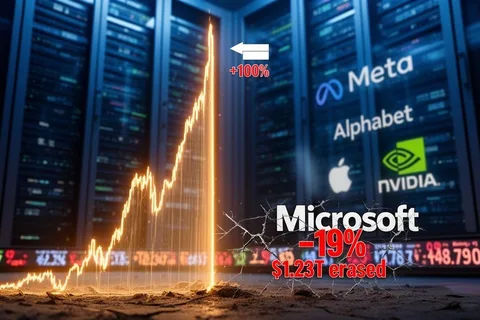
The first half of 2026 officially closed with a dramatic reshuffling within US technology stocks. The "Magnificent Seven" that once dominated the market have lost their luster, while memory chips and semiconductor equipment makers — previously viewed as cyclical sectors — have emerged as the most direct beneficiaries of the AI wave. Data shows the Philadelphia Semiconductor Index surged over 80% in the second quarter, bringing its first-half cumulative gain to more than 100% — its strongest semi-annual performance since the 1999 dot-com bubble. In stark contrast, the Nasdaq Composite rose approximately 12.8% over the same period, while the S&P 500 gained about 9.55%. The market's core logic is pivoting from "who owns the most advanced large language model" to "who is actually making money from AI," as investors rotate en masse from mega-cap tech stocks into memory chips, semiconductor equipment, and AI infrastructure suppliers. Semiconductor Supply Chain Celebrates; Memory Sector Emerges as Biggest Winner The biggest winners in the first half came almost entirely from the semiconductor supply chain, particularly the memory sector. As of June 30, SanDisk shares had skyrocketed over 850% in the first half, making it the best-performing stock in the S&P 500. Micron Technology followed closely with gains exceeding 300%, pushing its market capitalization past the $1 trillion mark for the first time and surpassing Berkshire Hathaway to enter the top ten US stocks by market value. Additionally, Western Digital, Intel, Seagate Technology, and Marvell Technology all posted gains exceeding 200%. The rally extended beyond memory, with the entire AI supply chain beginning to share in the windfall. TSMC rose approximately 57%, while lithography giant ASML gained about 86%. From GPUs, HBM high-bandwidth memory, and advanced packaging to wafer fabrication and equipment suppliers, the AI server value chain continues to expand outward. This explosive growth stems from a further surge in AI infrastructure demand. To maximize GPU performance, AI servers require more HBM high-bandwidth memory, higher-capacity DDR, and faster SSDs. The supply-demand imbalance has directly driven sustained increases in memory prices and significantly improved corporate earnings. Micron executives expect tight memory supply conditions to persist beyond 2027. Market analysts broadly agree that the memory industry has evolved from a traditional cyclical sector into a critical infrastructure asset for the AI era. Notably, AI chip leader Nvidia, despite continuing to hit record highs, posted a cumulative first-half gain of only about 7%, ranking at the bottom among Philadelphia Semiconductor Index constituents. Broadcom, Qualcomm, and other previously hot stocks also lagged the broader sector. Analysts note that massive AI chip spending is being dispersed across a wider range of semiconductor companies, with competition expanding from an initial head-to-head battle with AMD to include custom chip designers and CPU specialists like Intel. Magnificent Seven Face Reckoning; Microsoft Confronts Dual Headwinds While the upstream supply chain undergoes a valuation re-rating, downstream tech giants are facing harsh scrutiny from capital markets. As AI investment enters a cash-burning phase, the core question has become: when will these bets actually generate returns? In the first half, Microsoft led the Magnificent Seven's declines, dropping over 22%, with Tesla and Meta also posting losses of varying degrees. Only Google, Nvidia, Apple, and Amazon recorded gains. In June alone, the Magnificent Seven collectively shed approximately $2.3 trillion in market value, marking their worst single-month performance in a year. Microsoft became the biggest source of value destruction. The company's market capitalization had entered the $4 trillion club in late October last year, but by June 30, it had shrunk dramatically to $2.77 trillion. In June alone, Microsoft shares plunged nearly 20% — their worst monthly performance since the dot-com bubble burst in 2000. Market reports indicate Microsoft faces a unique "dual dilemma": on one hand, massive AI infrastructure capital expenditure is fueling investor concerns about returns; on the other, the development of AI could disrupt the profitability model of its traditional software business. Microsoft's CFO previously forecast that the company's full-year 2026 capital expenditure would reach $190 billion, a 61% year-over-year increase. Microsoft is not alone. Apple faces a different kind of pressure. Despite stable iPhone sales, Apple has yet to unveil an AI product capable of altering its growth trajectory. As component prices — including memory chips — continue to rise, Apple is being forced to passively manage cost pressures and raise product prices. Based on announced plans, the combined capital expenditure of Microsoft, Google parent Alphabet, Amazon, and Meta this year is expected to exceed $700 billion. This scale surpasses any previous cloud computing infrastructure expansion cycle, implying that mega-cap tech companies' free cash flow will remain under sustained pressure going forward. Valuation Divergence Intensifies; Volatility and Risk Coexist As the trend reaches extremes, the semiconductor sector's valuations and volatility have entered extreme territory. The Philadelphia Semiconductor Index currently trades at a forward price-to-earnings ratio of approximately 26 times, well above its 10-year average of 19 times. Among constituents, Arm Holdings trades at a forward P/E exceeding 140 times, while Intel sits at around 100 times. Nvidia, however, sits at the opposite extreme, with a forward P/E of only about 18 times — its lowest since 2018 — while Micron trades at roughly 8 times forward earnings. This massive valuation dispersion reflects severe disagreement in the market over expected AI investment returns. Meanwhile, volatility has surged dramatically. An index tracking the volatility of semiconductor ETFs has risen 83% year-to-date and is on track for its largest annual gain on record. Daily moves exceeding 1% for the Philadelphia Semiconductor Index have become the norm, with the period featuring both a single-day surge of 7.9% and an extreme single-day plunge of over 10%. According to Goldman Sachs prime brokerage data, hedge funds are offloading tech stocks at the fastest pace in a decade, while a frenzied influx of retail investors has further amplified price swings. Zhang Yi, CEO of iiMedia Research, told media that under the dominant AI computing mega-cycle, a structural reconstruction of industrial and capital pricing has already begun. Looking to the second half, the market's focus is no longer solely on the performance improvements of next-generation large language models, but on who can first demonstrate that massive AI investments can be sustainably converted into revenue, profit, and free cash flow. The upcoming second-quarter earnings season will serve as a critical checkpoint for testing this AI investment thesis.
Source: finance.biggo.com