



A Blue Origin rocket explosion leaves NASA leaning harder on SpaceX, and the Moon race suddenly has fewer engines to trust
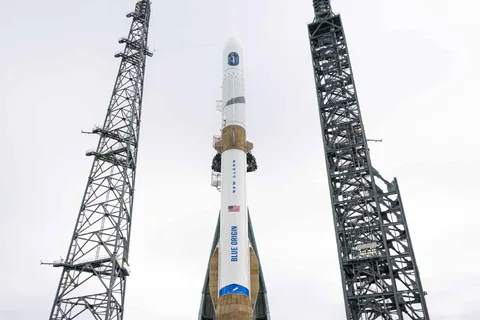
A rocket failure is never just a flash on a launch pad. When Blue Origin’s New Glenn exploded during a May 28 hotfire test at Cape Canaveral, it shook more than Jeff Bezos’ space company. It also exposed how much NASA’s next Moon plans depend on a small number of private contractors, launch pads, and unfinished spacecraft. Blue Origin later said all personnel were accounted for, while independent launch coverage described a fireball at Launch Complex 36 during prelaunch testing. The timing could hardly be more dramatic. SpaceX has just completed the largest IPO in history, closing the sale of 638,888,888 Class A shares and raising about $85.7 billion after underwriters exercised their full option. So while Blue Origin is rebuilding, SpaceX is entering public markets with fresh capital, a dominant launch business, and even more leverage in NASA’s race back to the Moon. A hard blow at the pad The New Glenn vehicle was undergoing a static-fire test, the kind of ground test where engines ignite while the rocket remains clamped to the pad. It was supposed to clear the way for a launch of Amazon low Earth orbit (LEO) satellites as soon as June 4, but the test ended with the rocket destroyed and the pad damaged. That is not a small delay. It is a break in the chain. Blue Origin’s own update offered a little good news. The company said the propellant farm, oxygen tanks, liquid hydrogen tanks, LNG tanks, and water tower were in good shape, while the big support tower was damaged but repairable in place. CEO Dave Limp also said Blue Origin expects to fly again before the end of 2026. Still, rockets are not cars in a garage. You do not just swap one out and move on. Launch infrastructure is specialized, expensive, and slow to rebuild, and that is why one bad night in Florida can ripple all the way into NASA’s lunar calendar. A rendering of SpaceX’s Starship Human Landing System on the Moon, a key element of NASA’s future Artemis lunar missions. Why NASA is exposed NASA’s revised Artemis III mission is now planned as a 2027 crewed demonstration in LEO. The agency says the mission will test systems needed for future lunar landings, including rendezvous and docking between Orion and commercial lander test articles from Blue Origin and SpaceX. Artemis III is meant to be a rehearsal before the United States sends astronauts back to the lunar surface with Artemis IV. That rehearsal is complicated. NASA’s June update said Blue Origin’s lander pathfinder would launch first and wait in orbit before Orion docks with it for about two days of testing. After that, Orion would separate and later dock with SpaceX’s Starship pathfinder for another round of checks. Now comes the uncomfortable question. What happens when one of those partners loses its launch path? Blue Origin’s Blue Moon program is not just a side project. NASA also awarded the company $188 million, with an option period worth $280.4 million, for two lunar delivery task orders tied to Moon Base infrastructure and rover delivery plans. SpaceX gets stronger SpaceX was already far ahead in launch cadence. BryceTech data reported by Via Satellite showed SpaceX completed 165 orbital launches in 2025, equal to nearly 51% of global orbital launches, and launched 85% of all satellites that year. Morningstar also estimated that SpaceX delivered 83% of the world’s mass sent to orbit in 2025. That is not just a lead. It is the kind of industrial rhythm competitors struggle to copy. The IPO gives that lead a financial spotlight. SpaceX shares began trading on June 12 under the ticker “SPCX,” and the offering closed on June 15 with roughly $85.7 billion in gross proceeds. For investors, the story is simple enough to understand at the kitchen table. SpaceX is not merely selling rockets. It is selling access to orbit. That matters for NASA, commercial satellites, and defense communications alike. Starlink rides on SpaceX rockets. Starship development rides on SpaceX cash flow. And NASA’s near-term lunar architecture, to a large extent, now has fewer practical alternatives if Blue Origin needs months to recover. The schedule problem Space experts were already warning that Artemis had little room for error. NASA’s Office of Inspector General said in March that both SpaceX and Blue Origin had faced schedule delays, technical difficulties, and integration challenges that could affect delivery timelines. The watchdog also said NASA was working with both providers to accelerate lander development toward a 2028 lunar landing date. Wendy Whitman Cobb, a professor at the U.S. Air Force School of Advanced Air and Space Studies, wrote that the New Glenn failure likely makes NASA “dependent on SpaceX for the time being.” That is a sober way to put it. SpaceX may be leading, but Starship still has to prove it can support the lunar version NASA needs. So this is not a clean win for Musk and a clean loss for Bezos. It is messier than that. A stronger SpaceX does not automatically solve NASA’s schedule problem if the Starship lander is late, because the whole Artemis plan depends on many difficult pieces working together. Blue Origin is not finished NASA selected Blue Origin in 2023 as its second Artemis lunar lander provider, with a $3.4 billion fixed-price contract for the Blue Moon system tied to Artemis V. At the time, NASA said having two different lander designs would bring more robustness, increase competition, and reduce costs for taxpayers. That logic still holds. However, redundancy is only useful when both lanes are open. Right now, Blue Origin is trying to prove that New Glenn can return quickly and safely, while NASA has to decide how much confidence to place in schedules that were already tight. It is a bit like planning a cross-country trip with two cars, only to discover one is still on the lift at the repair shop. For SpaceX, the moment reinforces its central position in the space economy. For NASA, it is a reminder that commercial partnerships can move fast, but they also concentrate risk in private hardware, private pads, and private timelines.