



By Tibi Puiu
Jun 16, 2026
Elon Musk's Space Empire Takes Him Across the Trillion-Dollar Line. Here Is What That Astronomical Fortune Means on Earth
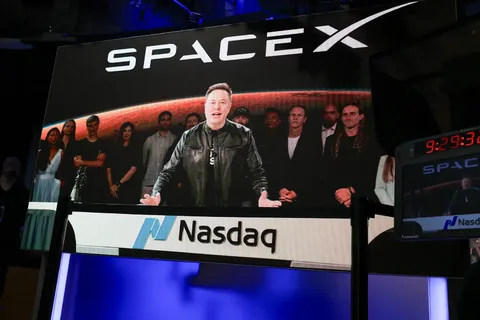
Credit: Nasdaq. One trillion dollars is the sort of figure that usually belongs to governments, war budgets and national economies. It never belonged to a biography, and some perhaps think it never should. Alas, after SpaceX surged 19 percent in its Nasdaq debut and the company’s market value vaulted past $2 trillion, that number attached itself to one person: Elon Musk, whose fortune Reuters reported had climbed to about $1.1 trillion. This milestone is more than a gawker’s statistic and marks a tipping point in the world economy, which is growing more unequal in almost every nation on Earth. Most of Musk’s wealth now rests in SpaceX alone, where his stake is now priced by the markets at about $866 billion. While the space industry now makes the serial entrepreneur the lion’s share of his wealth, let’s set to the uneasy task of translating these figures into something us puny mortals on Earth can actually grasp. But first, let’s start with a major asterisk. This is not cash stacked in a vault. It is wealth measured mostly in shares, options and investor belief. Investing.com quoted Matt Kennedy, a strategist at Renaissance Capital, saying that “SpaceX is a bet on Elon Musk.” Even if Musk liquidated all his stock, he’d never get close to a trillion. Second asterisk: SpaceX remains unprofitable even as investors rushed into the largest IPO in history, and the company generates only a fraction of the revenue brought in by similarly valued tech giants. We’re living in exuberant times to say the least, so keep your ears open for any ‘pop’. A Trillion Dollars in Ordinary Life To make a number like this readable, it helps to round Musk’s fortune down from roughly $1.1 trillion to a flat $1 trillion. Even after that haircut, the scale stays almost comically large. If it were split among U.S. households: FRED’s latest annual count shows 134.79 million U.S. households in 2025. If you divide $1 trillion by that number, each household gets about $7,419 . × If it were used to erase medical debt: KFF estimates Americans owe at least $220 billion in medical debt. A trillion dollars could wipe that out about 4.5 times. If it were measured against Washington’s biggest ledgers: The Congressional Budget Office says the Defense Department’s 2026 budget request totals $961 billion. The same agency projects Medicare’s 2026 net mandatory outlays at about $1.063 trillion. So, $1 trillion is slightly more than the Pentagon’s entire requested budget for the year and about 94 percent of one year of Medicare net outlays. If it were turned into national GDP: IMF data put Poland’s 2026 economy at about $1.13 trillion and Switzerland’s at about $1.15 trillion. A trillion dollars is not merely rich-person money. It is country-sized. If it were compared with Manhattan: The Bureau of Economic Analysis says New York County — Manhattan — produced $813.7 billion in real GDP in 2024. A trillion dollars is about 23 percent larger than the economic output of the most concentrated business district in the United States. If it were spent on Musk’s own cars: A Tesla 2026 Model Y starts at $41,630 . At that sticker price, $1 trillion could buy about 24 million Model Ys. If it were spent on milk: The Bureau of Labor Statistics puts the May 2026 average U.S. price of a gallon of whole milk at $4.217. At that price, $1 trillion would buy roughly 237 billion gallons. If it were spent on college: College Board says the average annual budget for a full-time in-state student at a public four-year college is $30,990 in 2025-26. That means $1 trillion could cover about 32.3 million student-years, or roughly 8.1 million full four-year in-state college paths. If it were spent on homes: The Census Bureau and HUD reported that the median sales price of a new house sold in April 2026 was $422,500. At that price, $1 trillion could buy about 2.37 million newly built homes. If it were spent on sports teams: Forbes’ 2025 ranking put the world’s 50 most valuable sports teams at a combined $353 billion. A trillion dollars could buy that whole list nearly three times over. If it were spent on gasoline: AP, citing AAA, reported U.S. gas prices at about $4.11 a gallon on Friday. At that price, $1 trillion would buy more than 243 billion gallons of gas — far above the nearly 137 billion gallons of finished motor gasoline Americans used in the previous year, according to the Energy Information Administration as reported by AP. If someone tried to spend it fast: Burn through money at $1 million an hour, every hour, without stopping, and $1 trillion would still last a little more than 114 years. The Number Says as Much About the Market as It Does About Musk In the same week that Musk crossed the line, not by any coincidence, SpaceX had become the sixth-largest U.S. company by market value, despite weaker present-day fundamentals than many of the firms it suddenly surpassed. That gap between current business and future expectation is where fortunes like this are born. Some of the faith is bluntly personal. JPMorgan Chase’s chief executive, Jamie Dimon, recently called Musk “the Edison of our time.” Whether that proves prophetic or wildly overstated, the quote captures the larger point: the trillion-dollar milestone is concentrated belief in one founder’s ability to bend markets around his ambition and deliver many trillions more than he is currently worth well into the future.
Source: ZME Science