



From bit to qubit. The future of computing is quantum
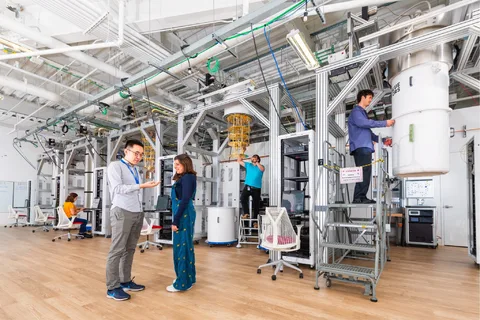
In 1968, when the film and the novel 2001: A Space Odyssey were released, Stanley Kubrick and Arthur C. Clarke imagined one of the most iconic machines of science fiction: HAL 9000, the supercomputer that governs the spaceship Discovery. Equipped with a very sophisticated artificial intelligence, HAL talks with the astronauts, understands language, makes autonomous decisions and shows emotions, such as the fear of dying, which leads it to kill, thus becoming the cinematic archetype of the computer that develops autonomy and becomes a threat. For the public of the time it was a futuristic vision. Yet, HAL did not come from nothing. Clarke had seen closely the large electronic computers of Bell Laboratories and IBM, remaining impressed by the performance of those new large computers with which a new technological era was starting. Since then, the history of computing has been marked by a succession of revolutions. From the first commercial computers of the 1950s to the personal computers of the 1980s, up to the arrival of machine learning and contemporary artificial intelligence, many scientific ideas have gradually entered reality. Already in 1947 Alan Turing predicted the appearance of “machines that learn from experience”: a description extraordinarily close to what we call today machine learning. It is therefore not surprising that computers and artificial intelligence have fed the collective imagination for decades, creating memorable stories in cinema as in literature. From HAL 9000 to the Artificial Friends told by the Nobel Prize winner Kazuo Ishiguro in the 2021 novel Klara and the Sun, science fiction has imagined very different futures for artificial intelligence. If HAL represents the fear that a machine can escape human control, Klara instead represents a completely different vision. Designed to keep company to children, this humanoid AI observes the world with curiosity and empathy and is willing to sacrifice itself for others. Characteristics that make Klara one of the most positive and humanly rich representations of artificial intelligence in contemporary narrative. The era of qubits While artificial intelligence is already transforming society, in laboratories all over the world a technology is taking shape that could redefine the very bases of computing: the quantum computer. The idea is almost 50 years old. At the beginning of the 1980s the Nobel Prize winner Richard Feynman observed that simulating the behaviour of matter at atomic level with a classical computer requires resources that grow rapidly until they become prohibitive. From this difficulty an intuition was born that would open an entire field of research: to effectively describe a quantum system it could be necessary to build a computer that directly exploits the laws of quantum mechanics. In other words, to use quantum physics to investigate quantum physics. This intuition, with the passing of time, is becoming real. In a few decades, in fact, the continuous miniaturisation of integrated circuits that form the hardware of modern computers has brought single memory cells closer and closer to the scale of atoms. At these dimensions, the rules of classical physics are no longer sufficient to describe their behaviour: the effects of quantum mechanics come into play. Qubit and bit Unlike traditional computers, which process information through bits that can take only the values 0 or 1, quantum computers use qubits, physical systems governed by the laws of quantum mechanics. Thanks to the principle of superposition, a qubit can be in a combination of different states at the same time: it is not simply 0 or 1, but it has a certain probability of being in both states until the moment of measurement. When more qubits are put in relation through the phenomenon of entanglement, their properties become correlated in a much deeper way. In these conditions the quantum system can no longer be described as a simple sum of its parts: the information is distributed over the whole set of qubits, allowing the exploration at the same time of a very large number of possible configurations and the development of computing strategies unreachable for conventional computers. If the classical computer was born from twentieth century electronics, the quantum computer is born directly from fundamental physics. Its units of information, the qubits, exploit phenomena such as superposition and entanglement, which for decades have been objects of study in physics laboratories all over the world. The same concepts that in the past seemed to belong only to the world of basic research are today at the centre of a new generation of technologies. For this reason, the race for quantum computing is not only an engineering or computing challenge: it is also the result of more than a century of research on the deepest nature of matter and fundamental interactions. As we have explained, quantum computers, thanks to their characteristics, could allow us to face problems that today are prohibitive even for the most powerful supercomputers and to overcome their limits: but transforming this promise into a mature technology is an enormous challenge. One of the main obstacles is the fragility of quantum states. The interaction with the external environment tends to quickly destroy superposition and entanglement, a phenomenon known as “decoherence”. For this reason the current prototypes, although in rapid progress, are still far from being technologically stable. Solving the problem of decoherence will be one of the determining factors for the success of one of the technologies on which researchers all over the world are working. Quantum computers in Italy However, progress is continuous. On 11 June the National Centre for Research in High Performance Computing, Big Data and Quantum Computing (ICSC) inaugurated at the DAMA Technopole of Bologna five new systems dedicated to high performance and quantum computing that expand and complete the Italian infrastructure for high performance computing and data analysis: LISA, MARCO POLO, GAIA, NOX and SOL. The Bologna hub, with these new machines, is today one of the most advanced quantum infrastructures in Europe. The infrastructure was realised thanks to resources destined to research and innovation by the Ministry of University and Research (MUR) within the PNRR, Next Generation EU, with funding of more than 49 million euros, and thanks to the European initiative EuroHPC (EuroHPC Joint Undertaking). Among these, NOX and SOL are the most advanced infrastructures on the quantum computing side. NOX and SOL, the quantum computers inaugurated at the Dama Technopole of Bologna. Italy NOX is an IQM Radiance quantum computer, equipped with 54 qubits, integrated with the Leonardo supercomputer of CINECA, and produced by the Finnish company IQM Quantum Computers. It uses superconducting circuits cooled to very low temperatures and is designed to work together with existing HPC supercomputing infrastructures. The technology on which NOX is based is one of the most widespread today in the sector, the same technological family used also by companies such as IBM and Google. The Radiance platform is designed for research centres and applications that combine classical high performance computing (HPC) and quantum computing. NOX is intended for research on optimisation, scientific simulations and quantum machine learning. It is the second IQM quantum computer installed in Italy. The first, inaugurated in May 2025, is called Lagrange, it is an IQM Spark with 5 qubits and is located at the Polytechnic University of Turin, where it is dedicated to research and higher education. SOL, whose name recalls light, in contrast with the very cold NOX, is a system developed by the French company Pasqal within the European EuroHPC programme in collaboration with an international consortium led by CINECA. SOL is a quantum system that uses a completely different technology: neutral atoms. Inside SOL there is a large ultra high vacuum chamber in which rubidium atoms are suspended and trapped by laser systems. To build qubits, the atomic levels of rubidium atoms are used. This technology is discussed in the latest issue of Particle Chronicle, the INFN newsletter, in the interview with the Nobel Prize winner Alain Aspect, who is also one of the founders of Pasqal. Moreover, in 2024, within the ICSC line dedicated to quantum computing (spoke 10), a prototype of a superconducting quantum computer had already been realised, in collaboration with the University of Naples Federico II. The machine was upgraded in 2026 with the installation of a more powerful processor, bringing the total number of qubits available in the system from the initial 25 to 64. The technological challenge of quantum computing The theoretical bases of quantum computing were laid in the 1980s by physicists such as Richard Feynman and David Deutsch. The first understood that quantum phenomena could be exploited to simulate nature, the second showed how they could form the basis of a universal computer. Today, more than forty years later, the challenge consists in transforming those ideas into a reliable and scalable technology. And it is exactly here that one of the most fascinating aspects of quantum computers emerges. Unlike what happened for the classical computer, as often happens in fundamental research, today there is still no dominant technology. Some research groups work on neutral atoms, which can be manipulated with precision by hundreds of laser beams. Others focus on trapped ions, on the use of photons or on superconducting circuits. In particular, INFN is actively involved in the development of these last two types of devices. Many of the technologies that today are in competition derive directly from tools and techniques developed within fundamental research. In this sense, quantum computers represent one of the clearest examples of how knowledge produced by physics can transform into technological innovation. Each approach presents specific advantages and difficulties. According to the physicist Alain Aspect, the neutral atom technology offers two particularly interesting advantages: the possibility to control a very large number of qubits in a relatively compact space and a greater resistance to decoherence phenomena. However, also the other platforms continue to make significant progress. Superconducting circuits, for example, are at the centre of investments by giants such as Google and IBM; photons show excellent performances in small systems; trapped ions guarantee an extremely accurate control of quantum operations. It is still early to understand which technology will become established and whether only one will prevail. Just as today we use different processors for different tasks, in the future we may discover that some quantum architectures are more suitable for the simulation of physical systems, others for the optimisation of complex networks, and others for the design of new materials or medicines. Also the decisive applications remain partly to be discovered. The most promising perspectives today concern the quantum simulation of matter and molecules, the study of the behaviour of matter at atomic level, with possible effects in chemistry and pharmaceuticals; in physics, the study of interactions between elementary particles; as well as the solution of extremely complex optimisation problems. Quantum sensors to search for dark matter There are many emerging quantum technologies, such as new generations of sensors, cryptography, quantum imaging, the study of the components of new quantum computers such as qubits, quantum computing and quantum simulations. Among the various research and development activities, the National Institute for Nuclear Physics (INFN) is involved in the Superconducting Quantum Materials and Systems Centre (SQMS) at Fermilab (Chicago, USA) for the development of sensors and quantum computers. SQMS has the ambitious objective of designing and building the most powerful quantum computer ever realised, a collaborative effort that involves 43 partners including INFN. One of the fundamental challenges that researchers are facing is how to extend the duration (called in physics coherence time) of qubits, the building blocks of quantum computers. SQMS will develop new quantum sensors, which could also find use in fundamental physics experiments for the search for dark matter and other elusive subatomic particles. Within the project, INFN will build in its Gran Sasso National Laboratories a laboratory for testing qubits in an environment with very low radioactivity, to understand how background cosmic radiation can affect their functioning. The quantum computer is not only the result of more than a century of research in fundamental physics, but it could become one of the most powerful tools to investigate the laws and the fundamental constituents of matter, just as was imagined, with extraordinary vision, by the pioneers of physics and computing. We do not yet know which technology will make future quantum computers possible. We do not know which applications will determine their success. But we know that we are at the beginning of a new scientific exploration and of a new technological revolution of computing. And, as often happens in the history of knowledge, every technological revolution opens new imaginaries.
Source: INFN - Istituto Nazionale di Fisica Nucleare