



India's robotics funding doubles in H1 FY26, but experts say it's too early to celebrate
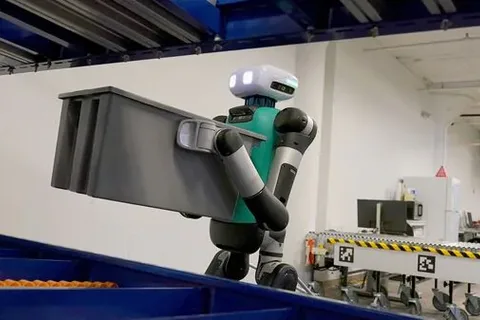
New Delhi: Funding for India's robotics start-ups almost doubled to $42.1 million in the first six months of 2026 from $22.7 million in the comparable span last year, with the average cheque size up 94.4% over the period, data platform Tracxn said. The funding was $35.8 million in the first half of 2024. While the rise in funding signals growing momentum in the sector, experts said it is still early days for India. In 2025, the country's robotics startups raised less than 1% of the capital secured by their US peers and about 2% of the amount raised in China, Tracxn said. Experts attributed the renewed investor interest in India's robotics to the maturing of technology. "As global pioneers approach public markets and demonstrate commercial success, a new generation of founders has gained confidence to build the next technology stack," said Bhaskar Majumdar, founder of Unicorn India Ventures, an early-stage venture capital firm. The latest example is US humanoid robotics startup Agility Robotics, which said earlier this month it plans to go public through a SPAC merger at a valuation of about $2.5 billion, highlighting growing investor confidence in the sector. Experts argued the increase in Indian government initiatives has also helped boost demand. Schemes such as Make in India, production-linked Incentives, and the push to reduce reliance on concentrated global supply chains, coupled with the growing global acceptance of Indian innovation, are driving investors towards deep tech sectors such as robotics. They said demand will only increase. "Most of these companies are at an inflection point. They spent seven or eight years building the business, but hardly anyone funded them," said Sumeet Seraf, founder of Equity 360, an investment banking and financial advisory firm. "Now, once they get that funding, these companies can see a J-curve kind of growth from here. If that happens, someone has to do a second round of funding, then a third round." Cheque size On the increase in the average cheque size from $1.8 million in 2025 to $3.5 million so far in 2026, experts said that the average round size alone is not sufficient to draw conclusions about an entire sector. "One explanation is that the ecosystem is maturing, and companies have reached stages where larger amounts of capital are required to execute their growth plans. It also depends on the quality and nature of investment opportunities available during a given period. Therefore, it would be premature to conclude that investors are simply becoming more selective," added Majumdar of Unicorn India Ventures. Amid the optimism, India's robotics sector continues to lag its global peers. Indian robotics startups raised only $52.9 million in 2025, compared with $5.6 billion raised by their US counterparts and $2.7 billion raised by Chinese robotics startups. Founders argue that building robotics products in India is challenging because many specialized components still need to be imported. "Many of the specialized components used inside the robot are not available from Indian manufacturers. That's one of the biggest challenges we face," said Rohit Ranjan, founder and chief executive of NeoGenTech, a startup that has built a female humanoid robot. "I have spent almost ₹ 8-10 lakh on components alone. If a component costs ₹ 20,000, importing it from the US or China increases the cost to ₹ 35,000-40,000." Even technically strong founders often struggle with go-to-market strategies and with rapidly testing and iterating in real manufacturing environments, experts argued. R&D focus missing "In India, the focus on R&D is missing. Based on the funding we get, it becomes hard to build in India. That's why people go overseas," said a founder of a robotics startup who has been trying to raise a seed round for his venture. India's R&D expenditure remains below 1% of GDP, compared with roughly 3.5% in the US and 2.6% in China. "Directionally, the trend is positive, but we need far bigger catalysts. Perhaps initiatives like RDIF funding will move the needle," said Nitin Sharma, founding partner of Antler India, an early-stage venture capital firm. "We need to get out of the 'chicken-and-egg' situation: VCs are scared of investing in hardware and talented founders are choosing to build elsewhere." RDIF refers to the Research Development and Innovation Fund, an initiative of the Department of Science and Technology with an outlay of ₹ 1 lakh crore over six years to support private enterprises, startups and industries in sunrise and strategic sectors.
Source: Mint