



SpaceX's 'Starlink Mobile' Vision Sends Aerospace ETFs Soaring; Semiconductor Funds Plunge on Meta-Triggered Overinvestment Fears
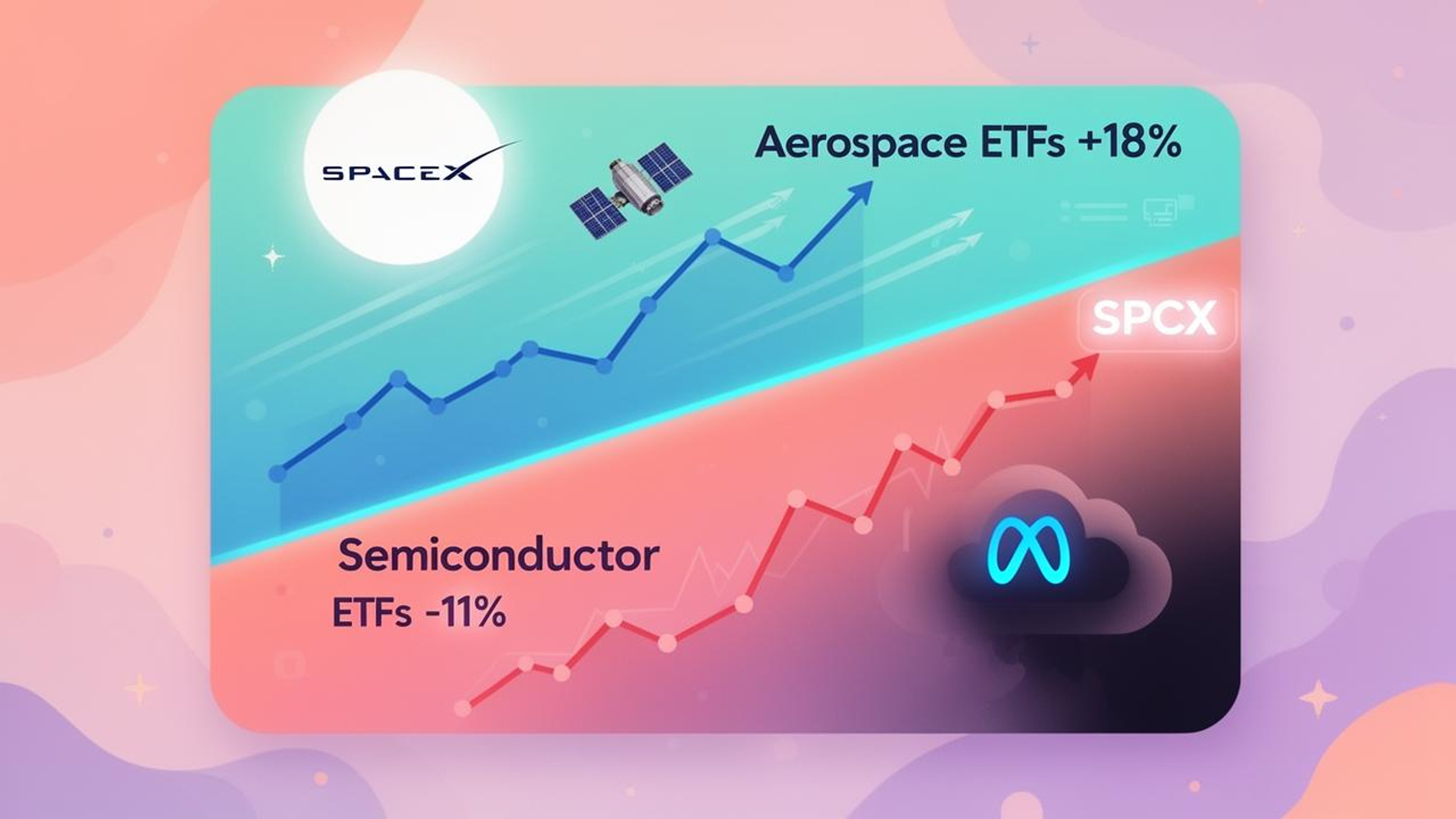
South Korea's exchange-traded fund (ETF) market saw two major sectors move in starkly opposite directions last week. While Elon Musk's SpaceX ignited an 18% surge in aerospace-related ETFs by fleshing out plans to enter the satellite-based mobile communications market, semiconductor ETFs tumbled as much as 11% amid a firestorm of debate over AI infrastructure overinvestment triggered by Meta. According to the Korea Exchange on July 5, the top-performing product in South Korea's ETF market from June 29 to July 3 was the 'SOL US Aerospace Top 10,' which skyrocketed 18.71%. The ranking excludes leveraged, inverse, and products with average daily trading volume below 100,000 shares, based on pure spot ETFs. The aerospace sector's outperformance was nothing short of dominant. Following the SOL US Aerospace Top 10, the 'KODEX US Aerospace' gained 17.62%, 'TIGER US Space Tech' rose 15.96%, and 'ACE US Space Tech Active' climbed 14.98%, sweeping the top of the returns leaderboard. The surge was directly triggered by SpaceX's new business vision. SpaceX shares rose 5.72% during the same period, and the aforementioned ETFs carry extremely high weightings in the company. Specifically, SOL US Aerospace Top 10 holds a 24.42% weighting, KODEX US Aerospace 22.18%, TIGER US Space Tech 23.53%, and ACE US Space Tech Active 28.92%. In effect, the price movement of a single stock — SpaceX — dictates the overall returns of these ETFs. The catalyst propelling SpaceX shares higher is the 'Starlink Mobile' concept. According to foreign media reports, SpaceX is planning a mobile communications service that directly connects smartphones to its satellite internet network. The core idea is to leverage a planned constellation of 40,000 low-Earth orbit satellites to deliver low-cost communications services across the globe. While the existing Starlink service provides internet via antennas installed at homes or offices, Starlink Mobile represents a revolutionary shift — enabling satellite communication through smartphones alone, without any additional equipment. This is being hailed as a potential game changer that could not only eliminate communications dead zones but also reshape the global telecommunications landscape. The AI semiconductor sector, meanwhile, moved in the exact opposite direction. The biggest decliner during the period was the 'TIGER US AI Data Center Top 4 Plus,' which plunged 11.77%. It was followed by a cascade of near-double-digit losses: 'TIGER Semiconductor Top 10' (-11.49%), 'PLUS Global HBM Semiconductor' (-11.02%), 'KODEX US AI Optical Communication Network' (-10.20%), 'HANARO US AI Memory Semiconductor Top 4+' (-9.95%), 'ACE AI Semiconductor Top 3+' (-9.52%), 'TIGER Global AI Active' (-9.52%), 'KoAct Global AI Memory Semiconductor Active' (-9.01%), 'KODEX Semiconductor' (-8.43%), and 'RISE AI Semiconductor Top 10' (-8.38%). The sell-off was sparked by news of Meta's entry into the cloud computing business. Reports that Meta plans to sell excess computing capacity from its AI data centers to external customers rattled the market. Until now, the dominant narrative had been that global Big Tech companies would compete endlessly to secure high-performance semiconductors like GPUs for AI model training and inference, prolonging a 'semiconductor supply shortage.' But when Meta — one of the industry's largest buyers — signaled it has spare computing resources to sell, it ignited a fierce debate over whether AI infrastructure investment has already overshot demand, fueling 'overinvestment' fears. This immediately triggered a correction in global AI and semiconductor stocks led by Nvidia, dragging down the returns of South Korean ETFs heavily loaded with these names. Products spanning the entire AI value chain — including HBM (high-bandwidth memory), optical communication networks, and data centers — fell in unison as investor sentiment rapidly soured. However, analysts are characterizing this correction as more of a technical retracement than a deterioration in AI industry fundamentals. Han Ji-young, an analyst at Kiwoom Securities, said, "To justify the claim that AI investment is in excess, phenomena like demand slowdown or demand shortfall would need to be confirmed by actual data, and we don't appear to have reached that stage yet." Han added, "This semiconductor-led correction appears to be largely technical in nature, following an historic rally during the second quarter of this year." In other words, the market is catching its breath after a steep run-up, rather than responding to an actual collapse in demand. South Korea's ETF market this week has been characterized by extreme sector divergence, with SpaceX-driven tailwinds for aerospace and Meta-driven headwinds for semiconductors buffeting the market simultaneously. The veracity of the AI overinvestment debate — now emerging as a key variable for second-half equity markets — and the pace of SpaceX's Starlink Mobile commercialization efforts are expected to serve as the critical inflection points determining the future direction of the ETF market.
Source: finance.biggo.com