



The Richest Grudge Match in History
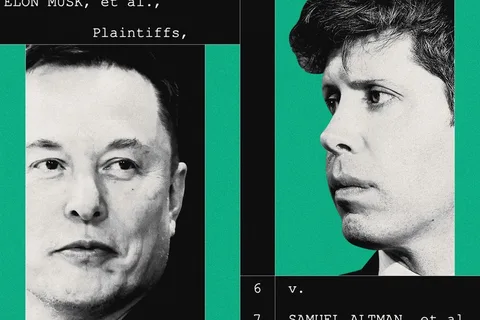
Elon Musk and Sam Altman are two of the most influential people in Silicon Valley, if not the world. Between them, Musk and Altman run technology companies worth many trillions of dollars that promise to reshape civilization. This morning, both sat under fluorescent lights in a courthouse in downtown Oakland, suffering through technical glitches as their respective attorneys kicked off the long-awaited trial in Musk v. Altman.
Musk is suing Altman and OpenAI, among others, demanding legal and financial remedies that would effectively destroy OpenAI as we know it. The fight stretches back to 2015, when Musk partnered with Altman to create OpenAI out of concern that Google DeepMind could not be trusted to create artificial general intelligence. They believed corporate greed would hinder societal progress, so OpenAI was founded as a nonprofit. After a falling out with Altman and other co-founders, Musk left in 2018. By 2024, OpenAI had shifted to a for-profit model and launched ChatGPT, becoming the fastest-growing consumer app in history. Musk sued, alleging that OpenAI violated its founding charter by prioritizing profits over its original mission and misused his charitable donations. Musk seeks Altman’s removal from OpenAI’s board, a return of allegedly ‘ill-gotten gains’ (around $150 billion), and conversion of OpenAI back to a nonprofit.
Legal experts note Musk’s argument is complex, as OpenAI has evolved from a nonprofit to a profit-driven entity. Critics claim it has strayed from its original mission of ensuring AI benefits humanity. Musk, however, insists OpenAI couldn’t sustain itself as a nonprofit. In 2018, he wrote an email suggesting merging OpenAI with Tesla to compete with Google. Before the lawsuit, Musk founded xAI, a rival for-profit company.
The trial highlights tensions between profit and social good in AI development. OpenAI’s co-founder Greg Brockman and Microsoft are also named in the complaint. OpenAI’s defense argues Musk’s lawsuit is hypocritical, given his own for-profit ventures and past criticisms of Altman. The trial’s pretrial process revealed internal communications, including Musk’s alleged use of a former board member (Shivon Zilis) to monitor OpenAI, and Altman’s claims of Musk’s insecurity.
The lawsuit’s broader implications extend beyond OpenAI. It reflects broader AI industry divisions: OpenAI’s split from Anthropic (founded by Dario Amodei and others), Musk’s xAI, and Meta’s (formerly Facebook) AI overhaul under Mark Zuckerberg. The trial underscores the AI boom’s origins in elite competition over control of transformative technology, raising questions about trust, governance, and the balance between profit and societal benefit. The trial’s outcome will illuminate deeper conflicts in AI’s development, shaping labor markets, education, and geopolitics.
Source: The Atlantic