



By @IntEngineering, Aamir Khollam
Jun 19, 2026
Three-armed kitchen robot cuts raw salmon with 95% touch-sensing accuracy
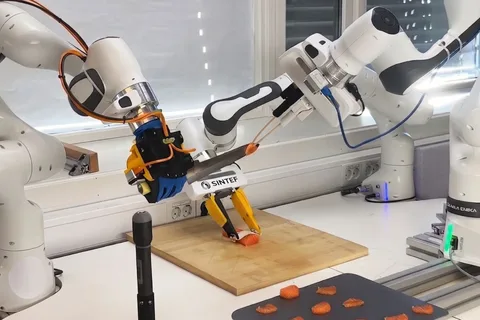
Industrial robots have mastered many repetitive tasks, but preparing sashimi remains a surprisingly difficult challenge. A piece of raw salmon rarely stays where it is placed. The fish deforms during handling, making it difficult for machines to deliver consistent cuts. Researchers in Norway have developed a robotic system that can prepare sashimi with minimal human involvement. The machine tackles a task that has long challenged robots because raw fish constantly changes shape during handling. The project highlights a broader goal in robotics. Engineers want machines to work with soft materials that do not behave predictably. Success in that area could benefit industries ranging from food processing to healthcare. Built for delicate tasks The research team at the Norwegian University of Science and Technology designed Sashimi-Bot around three robotic arms. Each arm performs a specific role. One arm stabilizes and positions the salmon before cutting begins. Another handles a chef’s knife. A third arm uses chopsticks to transfer finished slices onto a tray. Getting the fish into the correct position proved critical. A salmon loin can shift during handling, which affects cut quality. To address that issue, the researchers trained the robot in a virtual environment. The system relied on deep reinforcement learning, an AI technique that improves performance through repeated practice. During the simulation, the robot tested countless movements and gradually learned how to arrange the fish for slicing. The researchers then transferred that knowledge to the physical robot without additional training on real salmon. Giving the knife touch Cutting introduced another obstacle. The robot needed to know exactly when the blade reached the cutting board. That task becomes more difficult because the knife sits inside a soft robotic gripper. Small variations in the grip can affect the blade’s position during a cut. To solve the problem, the team equipped the system with a GelSight tactile sensor. The device uses a soft gel surface and an internal camera to detect pressure changes. Those measurements provide information similar to a sense of touch. Researchers trained the sensing system using more than 12,000 data samples collected during 157 cutting motions. The resulting model detected contact with the cutting board with 95% accuracy. It also achieved 99% precision during testing. That feedback allowed the robot to adjust its cutting motion before driving the blade too deeply into the board. Performance on salmon The team evaluated Sashimi-Bot using real salmon loins. During testing, the robot produced 34 slices ranging from 6 to 16 millimeters thick. Some pieces adhered to the knife after cutting, a common issue when working with raw fish. The robot successfully recovered all six of those slices directly from the blade. Most of the remaining pieces reached the serving tray without issue. The system successfully transferred 26 of 28 slices left on the cutting board. Only two failed transfers occurred, both involving extremely thin pieces that slipped from the chopsticks. The study was published in the journal npj Robotics.
Source: Interesting Engineering