



UBTech’s humanoid robots deployed to control crowds at China’s busy international border
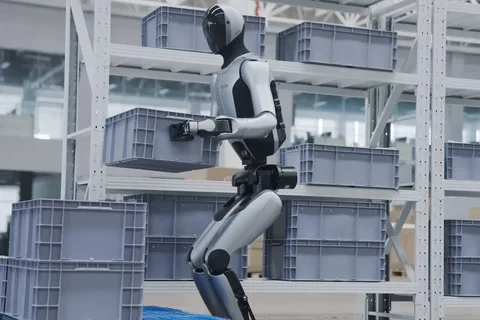
The deployment of humanoid robots also challenges the traditional boundaries of law enforcement authority. UBTech Robotics/YouTube China has deployed humanoid robots at its border with Vietnam to help ease congestion at one of its busiest international crossings. The move comes as the Fangchenggang border checkpoint in China’s Guangxi region struggles with heavy daily traffic from cargo trucks, buses, and commuters, creating delays during customs inspections. Border authorities have purchased Ubtech Robotics’ Walker S2 humanoid robots under a contract worth about $40 million. Although the number of robots has not been disclosed, initial deliveries have begun for deployment at key transit hubs. Recently, UBTech unveiled the UWORLD U1 Series, which it says is the world’s first full-size ultra-bionic humanoid robot lineup designed for mass production. Humanoids streamline customs Humanoid robots are being deployed at the Fangchenggang border crossing between China and Vietnam to assist with passenger management and cargo inspections as authorities seek to improve customs operations. The crossing, which includes Dongzhong Port and the nearby Dongxing Port, is a major gateway for cross-border passenger travel and freight transportation. Inside the passenger terminal, the robots help regulate the flow of international travelers by detecting crowd build-ups and directing people into organized queues. Using onboard AI, they provide real-time transit instructions in multiple languages, answer routine questions about customs procedures, and guide visitors to the appropriate processing gates. The machines also patrol terminal corridors, monitoring crowd density and helping authorities respond to congestion, reports Futura. Separate units are deployed in the freight area, where they inspect steel shipping containers as they move through busy cargo lanes. Equipped with optical scanners, the robots read barcodes, serial numbers, and digital shipping manifests before cross-checking the information against customs databases. The collected data is then transmitted to human officers at central command centers for further review. The Walker S2 is an industrial-grade humanoid designed for manufacturing and logistics. Standing 5.7 feet (1.76 meters) tall with 52 degrees of freedom and dexterous hands, it can lift up to 33 pounds (15 kilograms) per arm and perform precise manipulation tasks. It features a self-swapping dual-battery system for near-continuous operation, while BrainNet 2.0 AI, binocular stereo vision, and dynamic balancing enable autonomous navigation, human-like perception, and stable movement in complex industrial environments. Humanoids face reality The deployment of Walker S2 humanoid robots at the Fangchenggang border crossing is being closely watched as a major test of commercial humanoid robotics in a demanding real-world environment. Unlike controlled factory settings, the coastal border operates under high humidity, dust, changing weather, and constant movement of passengers and freight vehicles. The trial will evaluate whether humanoid robots can operate reliably under these conditions while maintaining consistent performance over extended periods, reports Futura. Chinese authorities see the project as a pilot for wider deployment across national infrastructure. If successful, similar humanoid systems could be introduced at airports, international railway stations, seaports, and other high-traffic transport hubs. The program also supports China’s broader strategy of advancing artificial intelligence, robotics, and automation for public services. The rollout, however, raises practical and legal questions. Human travelers may require time to adapt to interacting with humanoid machines performing customer service and security-related duties. Authorities must also determine how responsibility will be assigned if a robot makes an operational error during inspections or passenger processing. While the robots can automate routine tasks such as crowd management, information services, and cargo inspections, complex security decisions and law enforcement actions will continue to require human oversight. The outcome of the Fangchenggang trial could influence how quickly governments worldwide adopt humanoid robots for public infrastructure and border management, reports Futura.
Source: Interesting Engineering