



Video: Chinese humanoid robots go live on factory production line
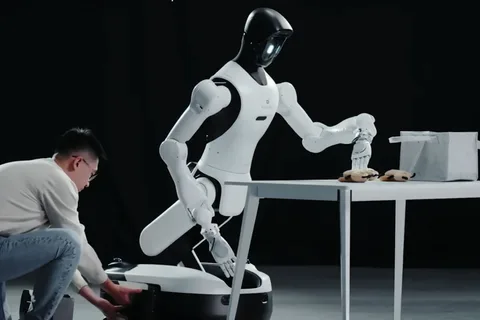
Agibot’s G2 robots inspect, handle and sort tablets autonomously at Longcheer’s Nanchang factory. Autonomous robot operations in a live factory environment, not a simulation or staged demonstration. Agibot/YouTube A Chinese robotics firm has begun livestreaming a fleet of its humanoid robots working autonomously on a tablet production line, showcasing real-world industrial deployment. The six-day broadcast features Agibot’s wheeled G2 robots handling tablet inspection and sorting tasks alongside human workers at a factory. According to Agibot, the robots processed more than 800 products without errors during the first three hours of operation. In February 2026, Agibot introduced an upgraded version of its G2 industrial robot, designed to deliver high-precision performance while maintaining the flexibility needed for complex manufacturing tasks. Tablet line automation The livestream follows a similar demonstration by US-based Figure AI, whose multi-day broadcast showed a team of Figure 03 humanoid robots sorting packages in a mock logistics environment. Agibot’s demonstration, however, takes place on an active manufacturing line and involves a larger fleet of robots operating alongside human workers. At Longcheer Technology’s tablet production facility in Nanchang, Agibot has deployed its wheeled G2 robots to perform key handling and inspection tasks as part of the manufacturing process. Equipped with specialized grippers, the robots pick up tablets from the production line, inspect them using onboard sensors, and place them into trays for the next stage of processing. The robots work continuously within the factory environment, coordinating with human employees and other automation systems. The fleet processed more than 800 tablets during the first three hours of the livestream without recording any errors, highlighting the system’s consistency and reliability in a real production setting. At the time of writing, the video describes the G2 robots as having already surpassed 10 hours of continuous operation, successfully sorting more than 3,000 items with a 100 percent success rate. Longcheer Technology is a major original design manufacturer (ODM) that develops and produces consumer electronics for global brands. Its customers include leading technology companies such as Xiaomi, Samsung, and Lenovo, making the deployment a notable example of humanoid robots being tested in large-scale electronics manufacturing operations. Precision mobility intelligence G2 is designed as a next-generation industrial humanoid that combines advanced AI computing, precision manipulation, and autonomous mobility for demanding commercial applications. According to Agibot, the robot is built entirely with automotive-grade components and delivers submillimeter positioning accuracy. Its dual-arm force-control system can detect and apply forces as low as 0.5 newtons, enabling delicate handling and assembly operations. At its core is NVIDIA’s Jetson Thor platform, providing up to 2,070 TFLOPS of computing power for real-time perception, decision-making, and motion control. The G2 features a 26-degree-of-freedom body and a 5-DOF waist-leg structure that supports fluid, human-like movement. Mobility is handled by a four-wheel steering system capable of omnidirectional travel, crab-walking, and zero-radius turns, allowing the robot to navigate crowded factory floors and confined workspaces. For human-robot interaction, the platform supports continuous multi-speaker conversations, 1:1 motion imitation, and ultra-low-latency teleoperation beyond visual line of sight. Operators can manage multiple robots simultaneously through time-sharing control systems. The robot is designed for 24/7 operation, with autonomous charging and hot-swappable dual batteries minimizing downtime. Safety is supported by a 360-degree surround-view perception system, high-precision collision detection, and a hybrid active-passive protection architecture. Agibot says the G2 has passed more than 130 validation tests, including extreme-temperature, electrostatic-discharge, and emergency-braking evaluations, demonstrating reliability for manufacturing, logistics, inspection, security, and research applications.
Source: Interesting Engineering