



Video: Robot dog delivers pulse-powered firefighting for safer emergency operations
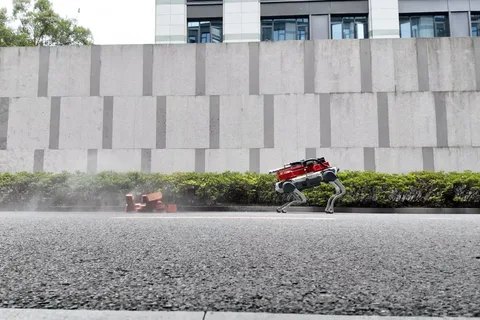
The robot delivers precise fire suppression while helping first responders safely access high-risk areas. DEEP Robotics/YouTube DEEP Robotics, a Chinese robotics company, has demonstrated an innovative fire-extinguishing robot dog designed to support firefighters in hazardous environments. The quadruped robot uses pulse-based technology to deliver highly efficient, zero-contact fire suppression while allowing operators to control it remotely from a safe distance. Equipped with precise fire source targeting and stable remote operation, the robot can access high-risk areas that may be too dangerous for human responders. Recently, DEEP Robotics showcased its DR02 humanoid’s firefighting skills while tackling tough terrain amid China’s growing robotics competition. Robots fight fires Firefighting remains one of the world’s most hazardous professions, with crews often forced to enter unstable, smoke-filled, and high-temperature environments where conditions can change in seconds. To reduce those risks, DEEP Robotics has now showcased its Pulse Firefighting Robot Dog, a quadruped robot designed to carry out remote fire suppression in areas that may be too dangerous for human responders. Unlike conventional firefighting systems that rely on continuous streams of water or foam, the robot uses pulse-based fire suppression technology, firing powerful, targeted bursts to extinguish flames efficiently while minimizing water consumption and collateral damage. The system enables zero-contact firefighting, allowing operators to remain at a safe distance while accurately targeting the source of the fire through remote control. In January, DEEP showcased a system that combines multiple robotic platforms to support firefighting operations in hazardous environments. Complimenting its Pulse robot dogs are water cannon robots that can project water or foam up to 60 meters with adjustable spray patterns for precise firefighting in obstructed areas. Both platforms feature dual-layer spray cooling to withstand extreme temperatures during extended missions. The system is further enhanced by autonomous wheeled-legged robots, low-latency communication, drone integration, real-time data transmission, and 3D point cloud mapping for improved situational awareness and coordinated emergency response. Mission-ready quadruped The DEEP Robotics X30, on which both pulse and canon robots are based, is designed for demanding industrial environments, combining advanced mobility, perception, and endurance to perform inspections and emergency response tasks in challenging conditions. The quadruped robot can climb industrial and open-riser stairs with slopes of up to 45 degrees, traverse uneven terrain, and step over obstacles exceeding 20 centimeters while maintaining stability. Its advanced traction control and adaptive gait algorithms enable secure movement across slippery, loose, or shifting surfaces, including gravel, sand, wet metal grating, and cluttered factory floors. The X30 features a multi-sensor fusion system that combines LiDAR, depth cameras, infrared imaging, and high-resolution visual sensors to provide reliable situational awareness. This allows the robot to operate autonomously in complete darkness, harsh sunlight, and rapidly changing lighting conditions while maintaining accurate mapping, obstacle detection, and path planning for uninterrupted inspections and patrols. Powering longer missions, the X30 offers up to 25 percent greater battery life than previous models. Its quick-release, tool-free battery system enables operators to swap batteries within seconds, minimizing downtime during industrial inspections, security patrols, and disaster response operations. According to DEEP Robotics, the combination of enhanced mobility, intelligent perception, and extended endurance makes the X30 well-suited for continuous deployment across factories, power facilities, remote infrastructure, and other hazardous environments.
Source: Interesting Engineering