



Hyperspace exploration using robotics for the discovery of mechanistically distinct transformations and complex functional products
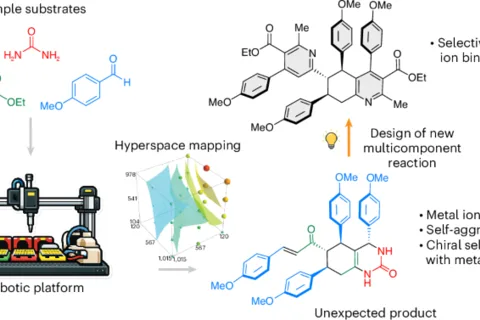
The discovery of new chemical reactions has historically been one of the most powerful drivers of progress in chemistry, enabling access to molecular architectures that underpin medicines, materials and catalysts. Traditionally, such breakthroughs have depended on human intuition, incremental exploration or chance observations. However, recent advances in chemical automation 1 , 2 , 3 , 4 and mechanism-level artificial intelligence 5 , 6 , 7 now offer the possibility of systematically probing chemical reactivity across multidimensional ‘hyperspaces’ of conditions. Exploring these landscapes in ways that transcend conventional intuition can reveal hidden reactivity even within exhaustively studied transformations. In this hyperspace perspective, reactions are reframed not as simple A + B → C processes, but as complex mechanistic networks that, upon condition changes, can be redirected into unexpected branches: as shown in our previous studies 1 , 2 , 3 , 4 where canonical syntheses yielded alternative reactivity patterns and products. However, until now, systematic hyperspace exploration has revealed only structurally simple molecules that remained tractable to human analysis. Here we show that robotics-assisted experimentation, combined with mechanism-aware algorithms, can discover transformations yielding products of far greater complexity and also functional utility. Focusing on the Biginelli multicomponent reaction (MCR), first reported in 1891 8 , 9 and long associated with dihydropyrimidinone heterocycles of biological relevance 10 , 11 , we integrate automated exploration, spectral analysis and chemical AI to reveal a previously uncharted region of its hyperspace. This region supports an unprecedented pseudo-seven-component transformation proceeding through a fragmentation-assembly mechanism, constructing bicyclic or even tricyclic cores unique for the Biginelli reaction and furnishing products that approach the architectural and stereochemical sophistication of some natural products 12 , 13 , 14 , 15 . Guided by algorithmic reconstruction of the underlying mechanistic network, we demonstrate scalable access to these scaffolds across a broadened substrate scope. These compounds also display rare supramolecular behaviours, ranging from concentration-dependent dimerization and tunable chiral self-assembly (previously seen only in select systems 16 , 17 , 18 , 19 , 20 ), to selective metal coordination, to metal-dependent homoochiral versus heterochiral sorting that, so far, has been observed only in G-quadruplexes of racemic nucleosides 21 , 22 . Together, these results show robotics-enabled and AI-assisted exploration of reaction hyperspaces, transforming chemical automation from a tool of speed into a platform for discovering new and functionally useful reactions that expand the boundaries of chemical reactivity. Results and discussion Hyperspaces and networks The hyperspace approach is conceptually akin to black-box methods in electronics, where the goal is to reconstruct an unknown circuit (here the reaction’s mechanistic network) by applying different electrical inputs (here distinct combinations of initial substrate concentrations) and analysing the resulting outputs (here the concentrations of all chemical species that form). Crucially, this is not a screening exercise aimed at finding optimal conditions for a known product; rather, it is a mechanistic interrogation of the system itself. Broad probing of the hyperspace is essential because different input concentrations selectively ‘activate’ or ‘deactivate’ distinct branches of the underlying network by modulating reaction rates and shifting equilibria, thereby enabling the formation of as many intermediates and products as possible: including unexpected ones that would remain invisible under classical screening paradigms. Achieving this requires automated exploration of thousands of conditions, encompassing not only automated reaction set-up (a standard capability of many chemical-automation systems) but also quantitative analysis of entire reaction crudes, capturing all components rather than only the expected major products typically targeted in optimization campaigns 23 , 24 , 25 (Fig. 1 ). The closed-loop algorithms that enable such high-throughput and inexpensive analysis of complex mixtures are a cornerstone of the hyperspace framework 1 , 2 . Here we apply this framework to deconvolute the hyperspace and mechanistic network of the Biginelli reaction involving aldehyde, β-ketoester and urea substrates under organic acid catalysis. Fig. 1: The Robowski platform and closed-loop hyperspace exploration. a , Photograph of the custom-built Robowski system for automated reaction handling and UV–Vis analysis. The set-up includes: (1) a horizontal two-axis gantry for robotic movement, (2) a liquid handling unit for precise pipetting, (3) pipette tip racks, (4) stock solution vials containing reactants, (5) solvent jars for reaction and dilution, (6) plates containing up to 54 reaction vials and (7) a Nanodrop UV–Vis spectrophotometer for automated spectrum acquisition. The blueprints for Robowski replication as well as all computer codes with which to operate it and analyse the results are freely available in ref. 1 . b , Scheme illustrating the closed-loop discovery protocol. The hypothetical space shown here (cube in the bottom row) is defined by concentrations of three substrates (in reality, we explore a four-dimensional manifold defined by the concentrations of the three substrates and the concentration of the CSA catalyst). At each point of this space, Robowski first takes a UV–Vis spectrum of the crude reaction mixture. Subsequently, all crudes are combined (flask in the top row) and this complex mixture is subject to iterative HPLC separation–NMR spectroscopy characterization cycles (outside the Robowski platform). Each purified component has its UV–Vis spectrum calibrated and catalogued. These UV–Vis spectra of the already-isolated components are linearly combined and fit against the dataset of all individual spectra from the hyperspace. Fit quality serves as a diagnostic for completeness: a high-quality global fit indicates that the ensemble of identified species sufficiently represents the chemical landscape. A poor fit, conversely, signals the presence of unaccounted species, prompting further HPLC–NMR spectroscopy purification cycles. Here only 8 HPLC–NMR spectroscopy iterations were needed to identify 12 key components that satisfactorily fit all 960 UV–Vis spectra in the hyperspace (Fig. 2a ). This ‘hyperspace mapping’ strategy is applicable to a broad scope of chemistries used in academic and industrial research but is not suitable for reactions involving, for example, purely aliphatic scaffolds (whose products give no signal in the UV–Vis range above 220 nm); for discussion, see ref. 1 . HRMS, high-resolution mass spectrometry. Closed-loop, robotic exploration of the Biginelli reaction space Our experiments were based on the low-cost, in-house-built Robowski platform (Fig. 1a ), integrated with spectral unmixing algorithms 1 , 26 , 27 (all replication blueprints and computer codes are provided in ref. 1 ) and performing sequences of reagent addition, mixing, temperature control and reaction characterization by ultraviolet–visible light (UV–Vis). Here this robotic system was used to probe a four-dimensional regular grid of 960 conditions defined by 4 initial concentrations of p -methoxybenzaldehyde ( p MBA) ([ p MBA] 0 = 0.1–1.0 M), 4 of ethyl acetoacetate (EAA) ([EAA] 0 = 0.1–1.0 M), 6 of urea ([urea] 0 = 0.1–1.0 M) and 10 of racemic camphorsulfonic acid ( rac -CSA) ([ rac -CSA] 0 = 0.1–1.0 M) acting as a catalyst. All reactions were performed at 100 °C for 24 hours and, afterwards, their individual UV–Vis spectra were acquired. Subsequently, all reaction crudes were combined, and this complex mixture was subjected to iterative cycles of high-performance liquid chromatography (HPLC) purification and NMR spectroscopy analysis (Fig. 1b ). In each cycle, fractions were further purified if they featured yet-unassigned NMR spectroscopy signals, and the UV–Vis spectra of these purified species were calibrated. As we discussed in detail in ref. 1 , the conceptual crux of this approach is to (1) fit (via the so-called spectral unmixing 1 , 24 , 25 ) the linear combinations of the spectra of the isolated species against all individual spectra acquired over the hyperspace, and (2) monitor the quality of fit. If the species isolated up to a given point assure a good global fit, then our understanding of the hyperspace can be deemed complete or nearly complete. If, however, the fit is poor, it means that some species forming somewhere in the hyperspace are unaccounted for, calling for another iteration of HPLC separation of the combined crudes, hopefully yielding additional products whose UV–Vis spectra can then be added to improve the global fit and decrease uncertainty. The key advantage of this approach is that it replaces exhaustive individual analyses of all 960 reaction crudes with rapid, low-cost UV–Vis profiling, supplemented by only a limited number (here, eight) of HPLC–NMR spectroscopy–spectral unmixing iterations, yet, it uncovers all compounds that form anywhere in the hyperspace in any appreciable amounts (for further details and discussion of limitations, see ref. 1 and caption to Fig. 1b ). The results of this close-loop campaign are summarized in Fig. 2a that plots the numbers of compounds identified in each cycle against the quality of fit against all UV–Vis spectra across the hyperspace. The first purification-identification-fitting involved only four compounds: two UV–absorbing substrates ( p MBA and EAA) as well as the expected main product, substituted 3,4-dihydropyrimidin-2(1 H )-one ( 1 in Fig. 2c ), and its extended derivative 2 , both known for the Biginelli reaction 28 . These four components alone were insufficient to adequately fit the UV–Vis spectra of all reaction mixtures in the hyperspace: that is, the spectral mismatch (defined as maximum difference between fitted spectra for each sample averaged over all 960 samples) was close to 0.1 absorbance units and notably above the instrumental noise (green band in Fig. 2a ). Accordingly, additional cycles were pursued, uncovering additional compounds but initially, not perceptibly decreasing the mismatch. Still, these new additions helped us gradually reconstruct the reaction network in Fig. 2c (discussion below) while also providing cues about which components may be missing. In this regard, discovery of 8a in the sixth cycle suggested that its precursor 7a should also be present. This compound was not isolated from the combined crudes but synthesized separately: indeed, inclusion of its UV–Vis spectrum in the eighth cycle caused a perceptible decrease in the mismatch down to ~0.03 absorbance units, still slightly above the instrumental noise (~0.02) but giving well-fitted spectra, such as the one shown in Fig. 2b . Fig. 2: Hyperspace content and reconstruction of reaction mechanism. a , Quality of global fits of components’ UV–Vis spectra to all 960 mixtures across the hyperspace. Vertical axis quantifies the distribution of the highest difference (across all spectral range) between experimental spectra and the fitted model: each datapoint corresponds to the crude spectrum for a single condition probed. Boxplot elements are the first quartile, the median and the third quartile. Whiskers are the 5% and 95% percentiles, with points outside this range (outliers) shown as black diamonds. Blue scatterplot shows all individual datapoints. Green stripe corresponds to the measurement/instrumental uncertainty determined in ref. 1 . The horizontal axis corresponds to the purification cycles with the numbers of mixture components isolated as follows: 4 components ( p MBA, 1 , EAA, 2 ), 6 components (+ E - 3 , Z - 3 ), 7 components (+ E , Z - 14 ), 8 components (+ 6 ), 9 components (+ 4 ), 10 components (+ 8a ), 11 components (+ 5 ) and 12 components (+ 7a ). b , UV–Vis ‘basis set’ of the 12 components used for fitting. c , Biginelli reaction network reconstructed according to isolated compounds (R: p -methoxyphenyl). The route to 8a was proposed with the help of mechanistic level chemical AI 5 , 6 , 7 : for details, see Extended Data Fig. 1 . Green arrows correspond to ex roboto reactions performed to substantiate the key aspects of the mechanism (two alternative paths to the classic Biginelli product 2 and one-pot reaction between 7a and urea to give unexpected product 8a ). d , The scheme on the right illustrates how each of the seven components contributes atoms to the unexpected product 8a (only two out of four copies of p MBA are drawn out). Crystal structure of 8a is shown on the right (thermal ellipsoids are shown at 50% probability level, the solvent molecule was omitted for clarity). Reconstruction of the Biginelli reaction network At this point, the chemical make-up of the hyperspace was well-approximated and the campaign was terminated identifying, in total, 12 species. Our next challenge was to establish the causal relationship between these species and arrange them into a mechanistic network (Fig. 2c ). For part of the network, this task was straightforward and rationalizing routes leading to 1 , 2 , 4 and 6 capitalized on the existing understanding 29 , 30 , 31 , 32 , 33 , 34 of the Biginelli reaction mechanism. In contrast, analysis for product 8a —never observed in the Biginelli reaction—proved considerably more challenging. Initially, we could not unequivocally assign its structure based on NMR spectroscopy and high-resolution mass spectrometry analyses but ultimately determined it by X-ray diffraction. As shown in Fig. 2d , this bicyclic core is decorated with four substituents, with all three substituents on the cyclohexene ring occupying pseudo-equatorial positions. A similar core, albeit with unsubstituted phenyl rings, was reported only once and was obtained via a multistep synthesis starting from 5 and relying on a sequence of four reactions 35 (Supplementary Scheme 1 ). In our case, the involvement of seven components (EAA, p MBA and urea in 2:4:1 stoichiometry) can be readily deduced but the lack of ethyl ester groups in the 8a structure proved harder to rationalize because we could not track all atoms from EAA. To propose a plausible reaction mechanism, we turned to chemical-AI tools. Specifically, we used our MECH algorithm 5 , 6 , 7 , which incorporates more than 10,000 expert-encoded mechanistic transforms: essentially digital versions of traditional arrow-pushing logic. MECH first maps out extensive mechanistic networks starting from the substrates, then searches those networks to identify reaction pathways that are compatible with the experimental conditions and lead from the starting materials to the observed products. Here MECH proposed a det
Source: Nature