



‘Iron Boy’ Review: A Gorgeously Hand-Painted Childhood Drama
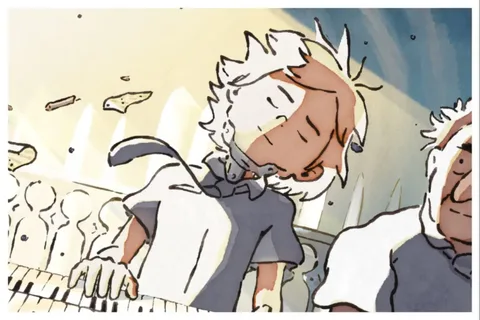
Departing from the 3D animation he contributed to at Pixar (“WALL-E,” “Up”) and wielded for his French co-directorial ventures (a pair of “Astérix” films), Louis Clichy ’s first solo feature is an alluring, hand-painted memory. Drawing from his upbringing in France’s agricultural Beauce region, and from his experience with a corrective corset, “ Iron Boy ” (or “Le Corset”) is both visually dazzling and deeply personal, making for a potential breakout from this year’s Cannes Film Festival . The story follow 11-year-old Christophe, voiced by Gary Clichy — the director’s own son, making the production intimate from the outset. Christophe is the spry, imaginative middle child to a stern farmer dad in an economically depressed countryside. Without explanation, Christophe begins to lean sideways and fall over, nearly causing a tractor accident and landing him in a metal brace along his torso and up to his chin. The late 20 th century is a world of machines, and Christophe is a part of it, whether he likes it or not. So, it’s somewhat fitting that his escape from mundanity, household pressures and his domineering father (Dimitri Colas) has a mechanical element too: the enormous Church organ at his parish, to which he takes a liking. Torn between toiling away at farmwork, his corrective swimming lessons, and learning music from a local organist — the elderly Michel (Alexandre Astier, Clichy’s former directing partner), who shows him more kindness than most — Christophe’s world gradually widens. However, it comes with the growing pains of adolescence, including a crush on a street-smart older girl, Clara (Brune Moulin), who ropes him into mischief as he tries to figure out how to fix a world out of balance. On occasion, Christophe’s boiling anger — born from his father’s temper, for reasons he keeps unhealthily close to the chest — results in spectacular formal flourishes, wherein the Earth as a whole leans and tips over alongside him, as though he were remaking it in his image. There’s religious iconography aplenty, between Christophe’s often eagle-armed posture — what child doesn’t see themselves as all-powerful? — and the frequent presence of churches. But these visual depictions of faith, and of the young protagonist’s inflated self-image, are also strengthened by Clichy’s judicious use of sound. It’s a film that feels aurally spiritual, despite its simple plot, owing to the choral echoes laid throughout the soundtrack. Conversely, the texture of the recordings (provided mostly by non-professional actors) plays an enormous part in making “Iron Boy” feel grounded and naturalistic too. This may seem in stark opposition to the aforementioned acoustic piety, but these dueling approaches form a beautiful medley of opposites, placing all things human right alongside all things divine, as Christophe attempts to ascertain the nature of both. On numerous occasions, Clichy places his voice actors on actual farms, circumventing the sterilized environment of the recording booth, and ensuring each vocal performance (including those far in the background) has a familiar timbre. Past the cartoon exterior is a tale of defining experience, residing deep within the recesses of the film’s (and the filmmaker’s) vibrant subconscious. “Iron Boy” is a film of reminiscence, taking shape through Chinese inkbrush paintings which make straight lines feel fluid, like memories, and which use negative space to denote light, transforming even emptiness into illumination. This style isn’t just attractive, and intimate, but philosophical in its approach to recollection, as though Clichy were looking back on moments of tumult not just as hurdles, but as building blocks for a better future — and a better relationship between the characters, who gradually learn from their strained dynamics, and learn to overcome them. It is, in a word, lovely.
Source: Variety