



American AI Companies Can’t Get Enough Chips
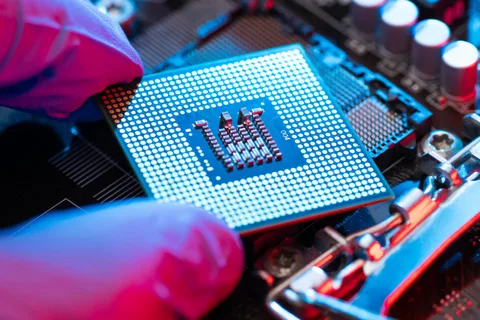
Executive Summary In 2026, artificial intelligence (AI) chip production has become a binding constraint on the pace of the AI compute buildout. Demand for computing power to train and deploy advanced AI models continues to grow exponentially, outpacing many chip manufacturers’ forecasts. Supply chains for AI chips and key inputs cannot scale rapidly enough to meet demand, as it takes years to build additional manufacturing capacity. Given these constraints on AI chip supply, the United States has both greater leverage and greater reason to ensure every chip is put to its highest-value use, giving rise to five key policy implications: As rising chip costs risk pricing out researchers and scientists, Congress should significantly increase funding for the National AI Research Resource to ensure compute access for public innovation keeps pace. Every chip exported to competing countries such as China is one fewer available to U.S. companies and democratic allies. Exports to China expand the compute accessible to the Chinese Communist Party (CCP) that can be used against American interests. Aggressively exporting AI chips to allies and democratic partners remains critical to enable U.S. AI companies to procure sufficient data center capacity and to ensure long-term American AI leadership. Chip shortages add urgency to countering chip smuggling. Location verification and stronger controls on high-bandwidth memory can help ensure scarce supplies are not diverted to unauthorized end users. New initiatives like Pax Silica have a vital role to play in coordinating efforts between allies, helping build out resilient semiconductor supply chains. Introduction Artificial intelligence (AI) chips are critical for AI progress, and American AI companies can’t get enough of them. They provide the computing power—that is, the “compute”—needed to train, deploy, and improve AI models. The more computing power AI companies amass, the better AI models they can produce. Since the release of ChatGPT in late 2022, spending on AI chips and data centers has grown exponentially. Microsoft, Alphabet, Amazon, Meta, and Oracle plan to spend almost $700 billion on capital expenditures in 2026, the majority for AI infrastructure. As of publication, AI companies have consistently said that they want to expand their compute faster than supply chains allow. However, AI chip manufacturing is becoming a binding constraint on the pace of the AI compute buildout. This was not always the case. Building compute requires several inputs, including the chips themselves, data centers to house them, and power for the data centers. In 2024 and 2025, the most common constraint on AI scaling was power for data centers. However, in 2026, the tightest constraint that AI companies face in procuring additional compute is shifting to the production of the AI chips themselves. As Sam Altman, chief executive officer (CEO) of OpenAI, put it: “It [the bottleneck] goes back and forth. Right now, again, it’s chips.” Chip supply has not kept pace with exponentially growing demand. Since building brand-new chip manufacturing capacity takes years, the bottleneck in chip production will likely be the rate-limiting factor on the AI compute buildout for at least the next year. AI chip manufacturing is becoming a binding constraint on the pace of the AI compute buildout. This bottleneck has several implications for U.S. AI policy, with scarcity increasingly making AI chips a strategic resource. Every chip sent to competitors such as China is one less chip available to American AI companies, raising prices and slowing America’s AI progress. This is even the case for older AI chips, like NVIDIA’s H200, as it uses the same limited manufacturing capacity needed for more advanced AI chips. It also means one less chip available for the America AI Exports Program, which depends on sufficient supply to cement the U.S. tech stack in strategic third markets. Finally, it underscores the importance of frameworks like Pax Silica to not only tackle the upstream challenges of critical minerals but also build a more resilient, long-term allied supply of AI chips. American AI Companies Can’t Get Enough Chips The compute used to build and run AI systems has been growing exponentially, driven by continued growth in compute used for training and enhancing new models, conducting research and development (R&D) to improve the next generation, and deploying models at scale. Although AI models are becoming more compute efficient, this has not reduced aggregate demand for compute. Surging demand from AI scaling and adoption has overwhelmed efficiency gains. Compute constraints force AI companies to make difficult tradeoffs between tightening usage limits on customers, raising prices to suppress demand, cutting R&D investment, training smaller models, and serving a lower-quality product. Each option means less revenue, slower capability progress, and a weakened competitive position. These tradeoffs are already playing out. Recently, Anthropic introduced stricter rate limits on Claude during peak hours to manage demand. Google CEO Sundar Pichai claimed Google is “supply constrained even as we’ve been ramping up our capacity.” The leaders of major AI companies and their suppliers have consistently echoed this assessment. These compute constraints are evident in AI chip rental prices. Historically, the cost of computing power has dropped exponentially over time, as more efficient hardware enters the market. However, analyses by Silicon Data and SemiAnalysis indicate that the rental price of the H100, a 2023 NVIDIA chip, is higher today than it was several years ago. In other words, chip demand has more than offset efficiency-related price reductions. The tightest constraint for a given company will depend on its existing contracts and assets. However, as companies forward plan to scale up compute, their leaders consistently point to a specific bottleneck limiting the pace of compute buildout: manufacturing capacity for AI chips. According to an executive at Broadcom, which designs Google’s AI chips, “We are seeing that TSMC is hitting [production-capacity] limits. . . . They will be increasing the capacity to 2027, but that has become a bottleneck.” Taiwan Semiconductor Manufacturing Company’s (TSMC’s) CEO, C. C. Wei, echoed this claim: “The bottleneck is TSMC’s wafer supply, not the power consumption.” What Drives Chip Shortages Chip manufacturers are reluctant to aggressively expand production for several reasons. First, long lead times, high capital costs, and boom-and-bust cycles are intrinsic to the business. Additionally, though, the memory of getting burned by overbuilding in response to inflated demand following the COVID-19 pandemic is still fresh. Automotive and consumer electronics manufacturers canceled orders early in the pandemic, anticipating a downturn. When the economy rebounded, they couldn’t secure adequate supply, as it had already been reallocated. This led to cars worth tens of thousands of dollars sitting unfinished on factory lots for want of chips costing only a few dollars, costing the automotive industry an estimated $210 billion in 2021. When manufacturers expanded capacity in response, they overshot actual demand as customers had been double-booking orders to ensure they got enough supply, leaving manufacturers with excess capacity and significant losses. The computer memory industry is especially susceptible to boom-and-bust cycles. Demand for memory can shift quickly, but new manufacturing capacity takes billions of dollars and many years to bring online. This timing mismatch can produce dramatic swings: High demand drives up prices and incentivizes investment, but by the time new capacity comes online, the industry has often overbuilt. These cycles have bankrupted company after company, consolidating the market from over 20 significant producers in the 1990s to just three main companies today: Samsung, SK Hynix, and Micron. These companies have seen demand spikes before and are wary of repeating mistakes that killed their competitors. These concerns make them hesitant to invest aggressively in response to surging demand from AI companies. TSMC, the Taiwan-based manufacturer that fabricates roughly 90 percent of the world’s most advanced chips, faces similar market dynamics. The company’s CEO has acknowledged this directly: “You essentially try to ask whether the AI demand is real or not. I’m also very nervous about it. . . . If we did not do it carefully, that will be a big disaster to TSMC for sure. . . . I want to make sure that my customers’ demands are real.” To hedge against the risk of evaporating AI demand, TSMC is also reserving capacity for customers with a long track record of reliable demand, such as Apple, even if that means accepting lower prices. This caution has directly contributed to the current AI chip bottleneck. Despite the surge in spending on AI chip investments after the release of ChatGPT, capital expenditures from TSMC and major memory manufacturers were lower in 2023 and 2024 than in 2022. While they are investing more aggressively now, it takes several years to build new manufacturing capacity. The concentration in the semiconductor industry means that there are not viable alternatives if demand spikes. Therefore, AI chip production is effectively capped by how much a few, cautious companies have invested in the past few years. AI-driven demand, meanwhile, has continued to skyrocket. As of April 2026, Anthropic’s annualized revenue has surged to $30 billion, up from $9 billion just four months earlier. This has caught chip manufacturing companies flat-footed. Reportedly, NVIDIA and Broadcom requested additional manufacturing capacity from TSMC, only to be turned down. Google has reportedly been unable to increase its AI chip production to meet its 2026 targets because it did not secure enough manufacturing capacity. These chip manufacturers are now investing more aggressively in additional capacity, but given the time required to bring new capacity online, the availability of AI chips will likely continue to be the tightest constraint on AI scaling in the near term. TSMC’s first Arizona fabrication facility (fab) is now producing four-nanometer (nm) chips, with five more fabs planned through a $165 billion investment. As the demand signals from AI companies work their way through the supply chain, other companies are making bets to increase chip supply, including xAI CEO Elon Musk’s ambitious goal of building his own fabs. Market forces will eventually boost supply to meet the demand, but that will take years to bear fruit. Tightness in the chip supply chain will remain through at least the end of 2026. Specific Bottlenecks Within AI Chip Production AI chips consist of several distinct components that share many manufacturing components with each other and with consumer hardware, such as smartphones. Key components include logic dies (which perform the computations) and memory, which is packaged with the dies on the same AI chip. Memory and logic wafer production for AI chips depends on the fabrication facilities (fabs) of a small number of companies. The production of logic dies and memory is particularly tight. Both rely on semiconductor fabs with highly sophisticated “clean rooms” to manufacture chips with ultraprecise lithography machines. These environments must be kept more pristine than a hospital operating room, as a single speck of dust can destroy chips during production. Building new clean rooms takes years, which is a main reason that production of logic and memory cannot respond quickly to surges in demand. Logic Wafers Finished logic wafers—the processed silicon discs from which individual logic dies are cut—are currently one of the tightest constraints on AI chip supply. Logic dies provide the core processing component of an AI chip, but logic wafers are also used to make networking chips, central processing units (CPUs), and parts of memory chips. NVIDIA, AMD, and other AI chip designers rely on TSMC’s world-leading, advanced node processes to fabricate their logic chips. But TSMC’s manufacturing capacity is finite in the short term and increasingly oversubscribed, given the surging demand for AI compute. As a result, even TSMC’s largest customers are short of supply. In November 2025, TSMC’s CEO stated that the company’s advanced process capacity was “not enough, not enough, still not enough” and that demand was running roughly three times ahead of what the company could produce. He also reportedly joked about wearing a shirt that read “no more wafers” to emphasize the severity of the shortage. TSMC’s production capacity for 3 nm chips stood at around 70 percent utilization in early 2025, but it has been near and even above 100 percent since late 2025, as the company pushes machines above their planned capacity, including by delaying maintenance. The company’s 3 nm node is especially constrained because it produces today’s most advanced AI chips, including NVIDIA’s Vera Rubin and Google’s TPUv7. The company’s 2 nm fabrication capacity is booked through 2028. TSMC cannot meaningfully ramp up advanced wafer manufacturing capacity in the near term because constructing additional fabs takes two to four years and sometimes longer. New capacity currently under construction is also unlikely to resolve the shortage. TSMC’s planned Arizona Fab 4 is already fully booked and the ground hasn’t even been broken yet. Other industries, such as smartphones, have historically consumed significantly more advanced logic wafer capacity than AI chips, so AI companies increased their chip production by simply outbidding those industries for production slots. However, with AI compute production growing at over three times per year, it is beginning to run up against TSMC’s total manufacturing capacity for certain manufacturing lines. Flagship customers such as Apple and Broadcom have explicitly stated that they are constrained by the available supply of TSMC chips, while the CEO of TSMC stated on the April 2026 earnings call that it will not be until 2027 that “supply can meet demand.” Memory Memory is another bottleneck. Smartphones and personal computers use dynamic random-access memory (DRAM) as
Source: Center for a New American Security | CNAS