



US' new humanoid robot can navigate dynamic environments without maps
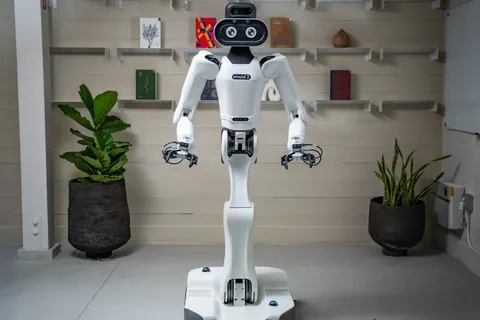
US-based Robot.com has launched R-Noid, a humanoid robot designed to perform repetitive, labor-intensive tasks across multiple industries. Offered through a Robot-as-a-Service model, the company said the robot can be deployed from initial site assessment to autonomous operation within eight to twelve weeks. The launch includes five solution categories—Restaurant Assistant, Packer, Picker, Folder, and Host—targeting persistent labor shortages in sectors such as industrial operations, logistics, healthcare, food services, lodging, and experiential venues. Robot.com said R-Noid is built to improve productivity while addressing workforce challenges. Humanoid robot tackles labor shortages R-Noid is a humanoid robo t platform designed for commercial and industrial environments, targeting repetitive tasks across logistics, manufacturing, healthcare, hospitality, and food service operations. The system combines autonomous mobility, AI-powered manipulation, and human-interaction capabilities on a single hardware and software platform. R-Noid features a dual-arm manipulation system with two 7-degree-of-freedom (DoF) robotic arms capable of handling payloads of up to 4 kilograms each. The robot also incorporates a 4-DoF articulated torso, providing a vertical working range from ground level to 6.2 feet (1.9 meters). This configuration enables the robot to reach shelves, workstations, conveyor lines, packing stations, and storage areas commonly found in industrial facilities. The humanoid stands 5.5 feet (1.7 meters) tall, weighs approximately 90 kilograms, and uses a holonomic mobile base that allows omnidirectional movement in confined and dynamic environments. According to the company, the design enables deployment in spaces originally built for human workers without requiring facility modifications. The platform supports both autonomous operation and VR-based teleoperation. During routine work, R-Noid can perform tasks independently, while remote operators can intervene when the robot encounters unfamiliar situations or edge cases. At launch, the robot can perform 19 deployable tasks across five solution categories: Restaurant Assistant, Packer, Picker, Folder, and Host. Demonstrated applications include assembling cardboard boxes from flat blanks, packing products for shipment, transferring items from conveyor systems, handling plastic parts on production lines, warehouse order picking, kitchen support, and linen folding, reports Street Insider. Multimodel AI humanoid R-Noid’s manipulation capabilities are powered by π0.7, a vision-language-action model developed by Physical Intelligence. The AI system combines visual perception with natural-language understanding, allowing the robot to interpret instructions, analyze its surroundings, and generate arm and hand motions required to complete tasks. The model is designed to adapt to changing object positions, layouts, and workflows without requiring extensive task-specific programming. For autonomy and navigation, Robot.com is collaborating with FieldAI. The robot utilizes FieldAI’s Foundation Field Models (FFMs), which serve as a generalized autonomy layer capable of operating across different environments. The company says the models enable robots to function in dynamic real-world settings without relying on pre-mapped infrastructure while maintaining physics-based reasoning to improve reliability and reduce errors. R-Noid is built on NVIDIA’s robotics ecosystem, with on-board NVIDIA Jetson computing modules handling perception, planning, and control functions. The company also uses NVIDIA Isaac Sim for simulation, validation, and testing before deployment, allowing robot behaviors to be evaluated in virtual environments before entering production facilities. The robot is powered by a battery system that provides approximately three hours of operation and supports continuous plug-in use for longer deployments. A modular end-effector architecture allows tools and grippers to be swapped for different applications. Robot.com has also incorporated its R-Soul software platform, which includes a front-mounted display, LED -based expression system, conversational interfaces, and customizable personalities. Developed with input from Japanese robotics company Yukai Engineering, the system is designed to communicate robot status, intent, and task progress while supporting branded customer-facing deployments. The company plans to deploy R-Noid through a Robot-as-a-Service model, with deployments progressing from site assessment and data collection to autonomous operation within weeks.
Source: Interesting Engineering